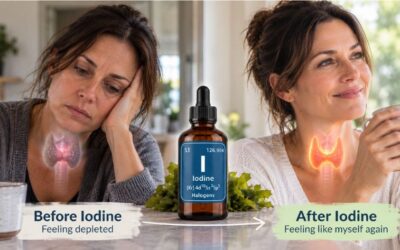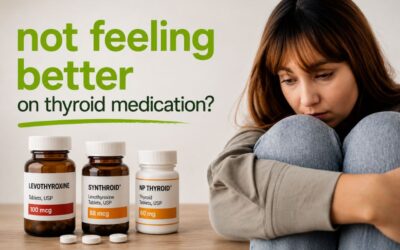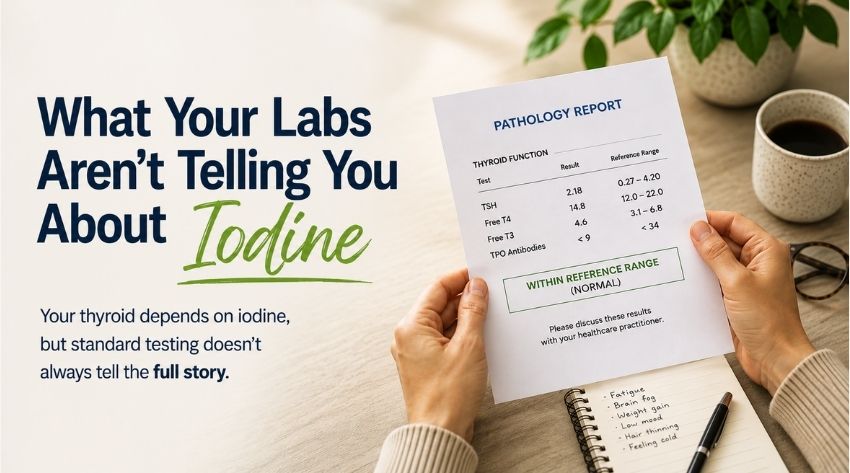







What if your thyroid isn’t actually fine, even though your labs say it is?
What if the reason you’re exhausted, cold all the time, gaining weight despite doing everything right, losing your hair, suffering from brain fog, puffy, inflamed, and just completely stuck — what if none of that is because you’re lazy or aging or doing something wrong?
What if it’s because one of the most important nutrients your thyroid, your cells, and your entire body depends on has been misunderstood, feared, and quietly ignored for decades?
That nutrient is iodine. And I want to have a real, honest conversation about it, because the way we’ve been taught to think about iodine has gone completely off track.
Iodine isn’t just a thyroid nutrient — it’s a whole-body nutrient
Here’s the thing that most people — including many heath professionals — get wrong. They think iodine’s job is just to help the thyroid gland make hormones. And yes, it does that. But iodine is involved in so much more than that.
Iodine plays a vital role in mitochondrial energy (and yes, that’s exactly what all you biohackers are chasing through your anti-aging protocols and peptides and everything else — iodine is the foundation!).
It supports cellular metabolism, detoxification, your immune system, breast tissue, ovarian tissue, prostate tissue, mucus balance, hormonal signaling, brain clarity, and even how nutrients actually get into your cells and toxins get out.
Every cell in your body is influenced by thyroid signalling. Your mitochondria have thyroid hormone receptors. Your breast tissue actually has four times the number of iodine receptors that your thyroid does. Let that land for a second. And most women with breast cancer are iodine deficient and full of bromide. That’s not a coincidence.
When I say iodine is foundational, I mean it. When the body is depleted of iodine, the whole system slows down.
Why so many of us are functionally iodine deficient right now
Here’s the part that breaks my heart, because it explains so much suffering. We’re living in a world that has dramatically increased our need for iodine while simultaneously flooding our bodies with compounds that compete with it, block it, and displace it.
Fluoride. Bromine. Chlorine. Microplastics. Heavy metals. Pesticides. Endocrine disruptors. Chemical additives in our food and water. These compounds sit in the same “parking spots” on your cells that iodine needs. They’re in the same column as iodine on the periodic table, so when they show up first, iodine gets locked out.
Fluoride is in your water, your toothpaste, your dental products. Bromine is in baked goods, in plastic flame retardants, in the fire retardant chemicals that Californians are literally breathing in during fire season. Chlorine is in your tap water, your pool, your cleaning products. And here’s the thing most people don’t think about: you might have a great filter in your kitchen for your drinking water, but what are you showering in? Chlorine and fluoride are notoriously difficult to remove from water.
Then add in microplastics, which are actually found in that iodized salt you’ve been taking thinking you’re getting your iodine. The microplastics block the iodine from even being absorbed properly.
And our soils are depleted. We’re more stressed. When the adrenals are under stress, they literally steal iodine away from the thyroid just to keep you alive. The adrenals are the backup battery pack, and they need iodine too.
So you can see how someone might technically be getting small amounts of iodine through their diet but still be functionally iodine deficient at the cellular level. Standard labs are not going to show you that.
Why your thyroid labs can look normal while you feel anything but
This is one of the biggest reasons iodine is so misunderstood: the conversation has been narrowed down to a couple of blood markers, and then people are sent home and told everything is fine.
You know the person I’m describing. Maybe that person is you. You’re eating clean, exercising, sleeping, taking your supplements. And you feel awful. Your body is moving through mud. You’re exhausted. Your hands and feet are always cold. You’re experiencing unexplained weight gain. Your mood is flat, your focus is poor, your hair is thinning, and your doctor looks at your TSH and T4 and says, “Everything looks normal.”
Here’s what those labs are not telling you. They’re not showing whether iodine is actually getting into the cell. They don’t show whether the toxic halogens we just talked about are blocking your iodine receptor sites. They don’t show whether the sodium iodide symporter — the transport system that moves iodine into your cells — is functioning properly. They don’t look at your adrenal function. And they don’t show tissue-level iodine deficiency.
A basic thyroid panel is also not telling you what your free T3 looks like, whether your liver is actually converting T4 into the metabolically active free T3, what your reverse T3 is doing, or what your thyroid antibodies are. All of these pieces matter.
Your thyroid doesn’t exist in isolation. It’s deeply connected to your liver, your adrenals, your mitochondria, your detox pathways, your sodium levels, your hydration, your minerals, your immune system, and your exposure to all of the environmental toxins that our grandparents never had to deal with.
A normal lab doesn’t always mean optimal function. Those reference ranges are built on the normal population, not the optimal population. And normal in today’s world isn’t exactly a high bar.
The Wolff-Chaikoff effect and the fear that took on a life of its own
So where did all this fear around iodine come from? A lot of it traces back to a 1948 paper that suggested excess iodine could temporarily suppress thyroid function. And from that, a fear was born that has been repeated and amplified in a way that is wildly oversimplified.
“Iodine is dangerous. It can shut down your thyroid. Be careful.” I’ve heard versions of this my entire career, and I know so many of you have been told the same.
But here’s what actually gets left out of that conversation: context matters enormously. The form of iodine matters. Your mineral status matters. Your detox pathways matter. Your liver function matters. Whether you have autoimmunity matters. How you dose matters, because starting too fast can release toxins faster than your body can clear them, which creates its own problems.
And here’s something that genuinely stopped me in my tracks. Dr. David Brownstein — the practitioner who was actually one of the people who started the myth that iodine should not be taken by people with Hashimoto’s — he was on my podcast. And he told me that when he made those early statements, he was at the very beginning of his practice and he didn’t know what he knows now. He is now a proponent of higher-dose iodine therapy. The man who started the fear is on the other side of it. That matters.
Why TSH sometimes rises when you start iodine — and why that’s not the disaster it looks like
This is a conversation I have to have over and over again, because people start iodine, their doctor runs labs, and then there’s panic. “Your TSH went up! Stop the iodine immediately!“
Here’s what’s actually happening. When iodine increases, it can stimulate the production of the sodium iodide symporter — that transport system that moves iodine into the cells. When your body recognises iodine after a long period of deficiency, it essentially says, “I need this, and I need more capacity to move it where it needs to go.” The TSH rising temporarily is the body asking for more transport capacity. It’s a sign of adjustment, not failure.
What you actually want to be asking during this time is: what are my free T3 and free T4 doing? Am I feeling worse or better? Is my body temperature improving? Am I as cold as I was before? How’s my energy? These are the meaningful signals.
HERE’S A LITTLE THYROID TEST TO TRY AT HOME!
Before you get out of bed in the morning, take your temperature!
The optimal basal body temperature is between 97.8 and 98.2 degrees Fahrenheit.
Your thyroid is essentially your body’s thermostat — it regulates how much heat and energy your cells produce. So when your temperature is consistently running below that range, it’s a signal that your metabolism is sluggish, your cells aren’t producing energy efficiently, and your thyroid may be underperforming even if your labs say otherwise.
This test costs nothing, takes ten seconds, and tells you something a standard blood panel often misses entirely.
You cannot talk about iodine without talking about salt and water
This is where so many iodine protocols fall short. Iodine doesn’t work in isolation. It absolutely needs sodium to do its job.
The sodium iodide symporter — the mechanism that gets iodine into your cells — depends on sodium to function. If you’ve been on a low-salt diet, you may be unknowingly making it impossible for iodine to get where it needs to go.
Now I’m not talking about the processed sodium in packaged foods. That’s not what we need more of. I’m talking about complete, unrefined salt — the kind that still has its minerals intact. When sodium is too low, the whole cellular transport system struggles. Your adrenals work harder to hold onto sodium, which is expensive from an energy standpoint and creates more stress on a system that is already depleted.
The way I think about it is this: take your iodine, wait about 12 minutes, then take a pinch of unrefined ancient salt in your water or on your tongue. That helps move the iodine into the cells and also helps support blood volume so your body can flush out the toxins that the iodine is working to mobilise.
Hydration matters too — so many people are walking around chronically dehydrated, and dehydrated cells cannot do their jobs.
Which salt should you use?
Not all salt is created equal. Highly refined table salt is heavily processed, stripped of many naturally occurring minerals, and often contains anti-caking agents and additives. While sea salt and Himalayan salt are popular alternatives, many people don’t realize that different salts contain varying mineral profiles.
For those looking to support hydration, electrolyte balance, and mineral intake, choosing a high-quality, mineral-rich salt can make a meaningful difference.
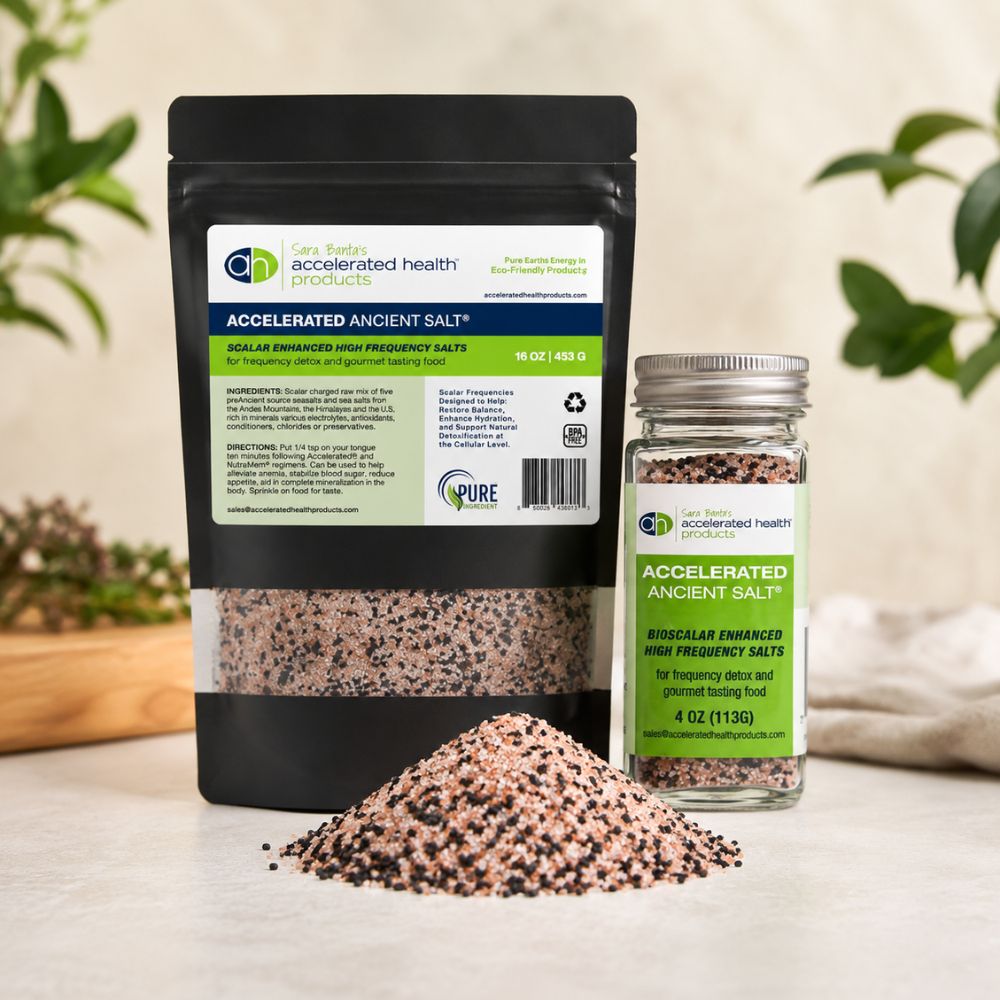
Accelerated Ancient Salt® combines five ancient sea salts sourced from around the world into one premium formula. Rich in naturally occurring trace minerals and electrolytes, it is designed to support hydration, mineral replenishment, and daily wellness. It is also commonly used alongside Acceleradine® to support cellular absorption of iodine.
Simply replace your regular table salt with Accelerated Ancient Salt™ and enjoy a cleaner, more mineral-rich alternative for everyday use.
Iodine doesn’t work in isolation. It absolutely needs sodium to do its job.
The sodium iodide symporter — the mechanism that gets iodine into your cells — depends on sodium to function.
Accelerated Ancient Salt® works in conjunction with Acceleradine®´iodine for optimal results.
What the research has been saying about higher iodine intake
Nobody is talking about this, and they should be. Because when you look at the actual research and the clinical experience of practitioners who have spent their careers working with iodine, the story is very different from what the standard fear-based narrative would have you believe.
Dr. David Marine conducted research with approximately 2,000 school girls from 1917 to 1922, using the equivalent of over 18,000 micrograms of iodine daily for two and a half years. The results demonstrated dramatic reduction in goitres, and this work eventually became the reason iodine was added to salt in the United States. Historically, iodine was not seen as dangerous.
Dr. Ghent studied fibrocystic breast disease in 1993, using 5,000 micrograms of iodine with 1,300 patients, and reported significant improvements with no side effects. This pointed to just how important iodine is for breast tissue, ovarian tissue, prostate tissue, and overall hormonal balance. Before reaching for HRT, the foundation has to be there first.
From 1997 to 2005, a large iodine project involving doctors Abraham, Brownstein, and Fletchas followed 4,000 patients using doses ranging from 12,500 to 100,000 micrograms daily. Over seven years, only three adverse reactions were reported, and those may not have even been from the iodine itself but from fillers or the source of the iodine. During that project they observed improvements in fibrocystic breast disease, reductions in insulin needs in diabetics, less need for hypothyroid medication, and improvements in fibromyalgia and migraine headaches.
The point is not that everyone should jump to high doses immediately. It is that we need a better, more nuanced, more honest conversation about what the research actually shows.
How to actually support your body while restoring iodine
If you’re considering adding iodine back in or increasing what you’re doing, there are a few things I think are essential to consider.
Start slow and increase gradually. This is not optional. As iodine begins mobilizing toxins — particularly the competing halogens like fluoride and bromide that have been sitting in your tissues — your body needs time and capacity to flush them out. If you move too fast, you can feel worse before you feel better.
Make sure your liver is supported. Over 50% of people have fatty liver disease right now, and the liver is where T4 gets converted to the active T3 your body actually uses. A sluggish liver means sluggish thyroid function, which further burdens the liver. It’s a cycle, and iodine is part of breaking it.
Pair your iodine with unrefined salt and good hydration. Make sure your detox pathways are actually open and functioning. And use a clean form of iodine without fillers, synthetic binders, or contamination concerns — sourcing matters.
Why Acceleradine® is the form of iodine I recommend — and why practitioners agree
I want to talk about something that doesn’t get nearly enough attention in the iodine conversation, and that’s the fact that not all iodine supplements are created equal. The form of iodine you take matters enormously, and this is one of the biggest reasons some people try iodine and don’t feel the difference — or worse, feel worse.
Most iodine supplements on the market are either bound to a salt compound (potassium iodide), derived from sources with questionable purity, or filled with binders, fillers, and synthetics that create their own detox burden. Some iodine sourced from Asia carries contamination concerns related to radioactive fallout from Fukushima. And many supplements simply don’t absorb well at the cellular level, which defeats the whole purpose.
Acceleradine® iodine is different, and this is why I developed it and why it’s become the form that practitioners who work in functional and integrative medicine keep coming back to. It’s a single-atom iodine — meaning it exists as individual iodine atoms rather than bound molecular forms. That matters because single-atom iodine is what the body’s sodium iodide symporter is actually designed to transport directly into the cells. You don’t need the body to first break apart a compound before it can use what’s inside. The iodine is immediately bioavailable, which means it’s getting to the thyroid, the mitochondria, the breast tissue, the ovaries, the immune system — everywhere it needs to go — far more efficiently than most other forms.
It’s also charged with scalar frequencies, which is something that I know can sound unusual if you haven’t come across it before, but the principle is this: those frequencies help support the vibrational integrity of the iodine at a cellular level and support the body’s own energetic environment as it detoxifies. Practitioners who are working with patients on comprehensive detox and thyroid restoration protocols increasingly appreciate this aspect of Acceleradine because they’re seeing the results in their patients — better tolerance, smoother detox response, and more consistent improvements in energy, body temperature, and metabolic function.
It’s also completely clean. No fillers, no synthetics, no binders. Just pure, bioavailable iodine in a base of distilled water and alcohol at a concentration that allows for precise, gradual dosing. This is critical because one of the non-negotiables I always come back to is starting slow and increasing gradually. Acceleradine’s drop-based format makes that easy — you can start with just a few drops and work your way up at a pace your detox pathways can actually handle.
Practitioners are also recommending it because of the protocol flexibility. It pairs beautifully with unrefined salt to support the sodium iodide symporter, and when used alongside liver support — which I consider non-negotiable given how many people are dealing with fatty liver right now — the whole system responds more predictably and comfortably.
If you’ve tried iodine before and felt off, it is absolutely worth asking what form you were taking, what the source was, whether you were supporting your detox pathways, and whether you were moving too fast. In my experience, Acceleradine® removes a lot of the variables that can make iodine feel complicated.
The bottom line on iodine
If there’s one thing I want you to take away from everything we’ve covered today, it’s this: iodine is not something to fear. It’s something your body has been quietly asking for, possibly for years.
The fatigue, the cold hands and feet, the weight that won’t budge, the brain fog, the hair loss — none of that is just aging. None of it is inevitable. And none of it means your body is broken. It may simply mean that one of the most foundational nutrients in human physiology has been blocked, displaced, or depleted — and that the standard testing we’ve all been relying on was never designed to catch it.
The good news is that this is fixable. Start slow, support your detox pathways, pair your iodine with good unrefined salt and hydration, give your liver what it needs, and use a clean bioavailable form. Your body knows exactly what to do with iodine when it finally gets it.
You are not lazy. You are not broken. You are depleted. And there is a difference.
Frequently Asked Questions About Iodine
This is one of the most common questions I get, and the fear around it is real — but it’s also been significantly overstated. The blanket advice that people with Hashimoto’s must avoid iodine is not supported by the current evidence when iodine is introduced slowly, alongside adequate selenium, with liver and detox support, and in a clean, bioavailable form. The practitioner who originally promoted that restriction has since reversed his position. Context, form, dose progression, and supporting nutrients all matter enormously here.
Standard thyroid panels are not designed to assess iodine status at the cellular level. Look at your symptoms: chronic fatigue, cold hands and feet, low basal body temperature, sluggish metabolism, hair thinning, brain fog, constipation, breast tenderness, poor mood. Your basal body temperature before you get out of bed in the morning is one of the most useful quick indicators of thyroid and metabolic function that costs nothing.
When iodine is reintroduced after a period of deficiency, the body can temporarily increase TSH as part of upregulating the machinery needed to transport iodine into cells. This is not necessarily a sign that iodine is harming your thyroid. It’s worth monitoring your free T3 and T4, your symptoms, your energy, and your body temperature alongside the TSH number rather than reacting to TSH in isolation.
For most people living in the modern world with the level of toxic halogen exposure we have today, the answer is no. The amount of iodine in iodized salt is based on minimum requirements from a very different era. Most gourmet, Himalayan, and Celtic salts don’t even contain meaningful iodine. And iodized table salt often comes with microplastics that actually block iodine absorption. I recommend getting iodine from a clean, highly absorbable supplement rather than relying on salt for iodine intake.
This is one of the most underappreciated pieces of the iodine conversation. Breast tissue has four times more iodine receptors than the thyroid gland. Iodine plays a direct role in breast tissue health, and fibrocystic breast disease has been shown in clinical research to improve significantly with iodine supplementation. Most women with breast cancer are iodine deficient. This does not mean iodine is a treatment for cancer — but it does mean we should be taking the connection between iodine and breast tissue health very seriously.
Iodine deficiency is actually the number one nutritional cause of depression worldwide. Your brain depends on adequate thyroid hormone, and thyroid hormone depends on iodine. Mitochondrial energy — which is what your brain runs on — is directly tied to thyroid function and iodine status. I firmly believe that testing thyroid function should be a first step in any mental health evaluation, and yet it’s almost never done routinely.
Absolutely. Iodine has antiviral, antibacterial, antifungal, and antiparasitic properties. Your mucous membranes use it. Your immune system depends on it. And there is fascinating research showing that iodine may help restore the function of the p53 gene — the gene responsible for identifying and eliminating diseased cells — which has been shown to be suppressed in certain conditions. Iodine is not a miracle cure, but it is genuinely foundational to immune function.

Sara Banta
Sara Banta is an NANP Certified Dietary Supplement Professional, Health Coach, and CEO & Founder of Accelerated Health Products. She is also the host of the top-rated podcast Accelerated Health with Sara Banta, where she shares practical strategies to support energy, metabolism, hormones, and overall wellness. Sara is passionate about helping people take control of their health naturally through education and innovative formulations.
- Sara Banta
- Sara Banta
- Sara Banta
- Sara Banta
- Sara Banta
- Sara Banta
- Sara Banta
- Sara Banta
- Sara Banta
- Sara Banta
- Sara Banta
- Sara Banta
- Sara Banta
- Sara Banta
- Sara Banta
- Sara Banta
- Sara Banta
- Sara Banta
- Sara Banta
- Sara Banta
- Sara Banta
- Sara Banta
- Sara Banta
- Sara Banta
- Sara Banta
- Sara Banta
- Sara Banta
- Sara Banta
- Sara Banta
- Sara Banta
- Sara Banta
- Sara Banta
- Sara Banta
- Sara Banta
- Sara Banta
- Sara Banta
- Sara Banta
- Sara Banta
- Sara Banta
- Sara Banta
- Sara Banta
- Sara Banta
- Sara Banta
- Sara Banta
- Sara Banta
- Sara Banta
- Sara Banta
- Sara Banta
- Sara Banta
- Sara Banta
- Sara Banta
- Sara Banta
- Sara Banta
- Sara Banta
- Sara Banta
- Sara Banta
- Sara Banta
- Sara Banta
- Sara Banta
- Sara Banta
- Sara Banta
- Sara Banta
- Sara Banta
- Sara Banta
- Sara Banta
- Sara Banta
- Sara Banta
- Sara Banta
- Sara Banta
- Sara Banta
- Sara Banta
- Sara Banta
- Sara Banta
- Sara Banta
- Sara Banta
- Sara Banta
- Sara Banta
- Sara Banta
- Sara Banta
- Sara Banta
- Sara Banta
- Sara Banta
- Sara Banta
- Sara Banta
- Sara Banta
- Sara Banta
- Sara Banta
- Sara Banta
- Sara Banta
- Sara Banta
- Sara Banta
- Sara Banta
- Sara Banta
- Sara Banta
- Sara Banta
- Sara Banta
- Sara Banta
- Sara Banta
- Sara Banta
- Sara Banta
- Sara Banta
- Sara Banta
- Sara Banta
- Sara Banta
- Sara Banta
- Sara Banta
- Sara Banta
- Sara Banta
- Sara Banta
- Sara Banta
- Sara Banta
- Sara Banta
- Sara Banta
- Sara Banta
- Sara Banta
- Sara Banta
- Sara Banta
- Sara Banta
- Sara Banta
- Sara Banta
- Sara Banta
- Sara Banta
- Sara Banta
- Sara Banta
- Sara Banta
- Sara Banta
- Sara Banta
- Sara Banta
- Sara Banta
- Sara Banta
- Sara Banta
- Sara Banta
- Sara Banta
- Sara Banta
- Sara Banta
- Sara Banta
- Sara Banta
- Sara Banta
- Sara Banta
- Sara Banta
- Sara Banta
- Sara Banta
- Sara Banta
- Sara Banta
- Sara Banta
- Sara Banta
- Sara Banta
- Sara Banta
- Sara Banta
- Sara Banta
- Sara Banta
- Sara Banta
- Sara Banta
- Sara Banta
- Sara Banta
- Sara Banta
- Sara Banta
- Sara Banta
- Sara Banta
- Sara Banta
- Sara Banta
- Sara Banta
- Sara Banta
- Sara Banta
- Sara Banta
- Sara Banta
- Sara Banta
- Sara Banta
- Sara Banta
- Sara Banta
- Sara Banta
- Sara Banta
- Sara Banta
- Sara Banta
- Sara Banta
- Sara Banta
- Sara Banta
- Sara Banta
- Sara Banta
- Sara Banta
- Sara Banta
- Sara Banta
- Sara Banta
- Sara Banta
- Sara Banta
- Sara Banta
- Sara Banta
- Sara Banta
- Sara Banta
- Sara Banta
- Sara Banta
- Sara Banta
- Sara Banta
- Sara Banta
- Sara Banta
- Sara Banta
- Sara Banta
- Sara Banta
- Sara Banta
- Sara Banta
- Sara Banta
- Sara Banta
- Sara Banta
- Sara Banta
- Sara Banta
- Sara Banta
- Sara Banta
- Sara Banta
- Sara Banta
- Sara Banta
- Sara Banta
- Sara Banta
- Sara Banta
- Sara Banta
- Sara Banta
- Sara Banta
- Sara Banta
- Sara Banta
- Sara Banta
- Sara Banta
- Sara Banta