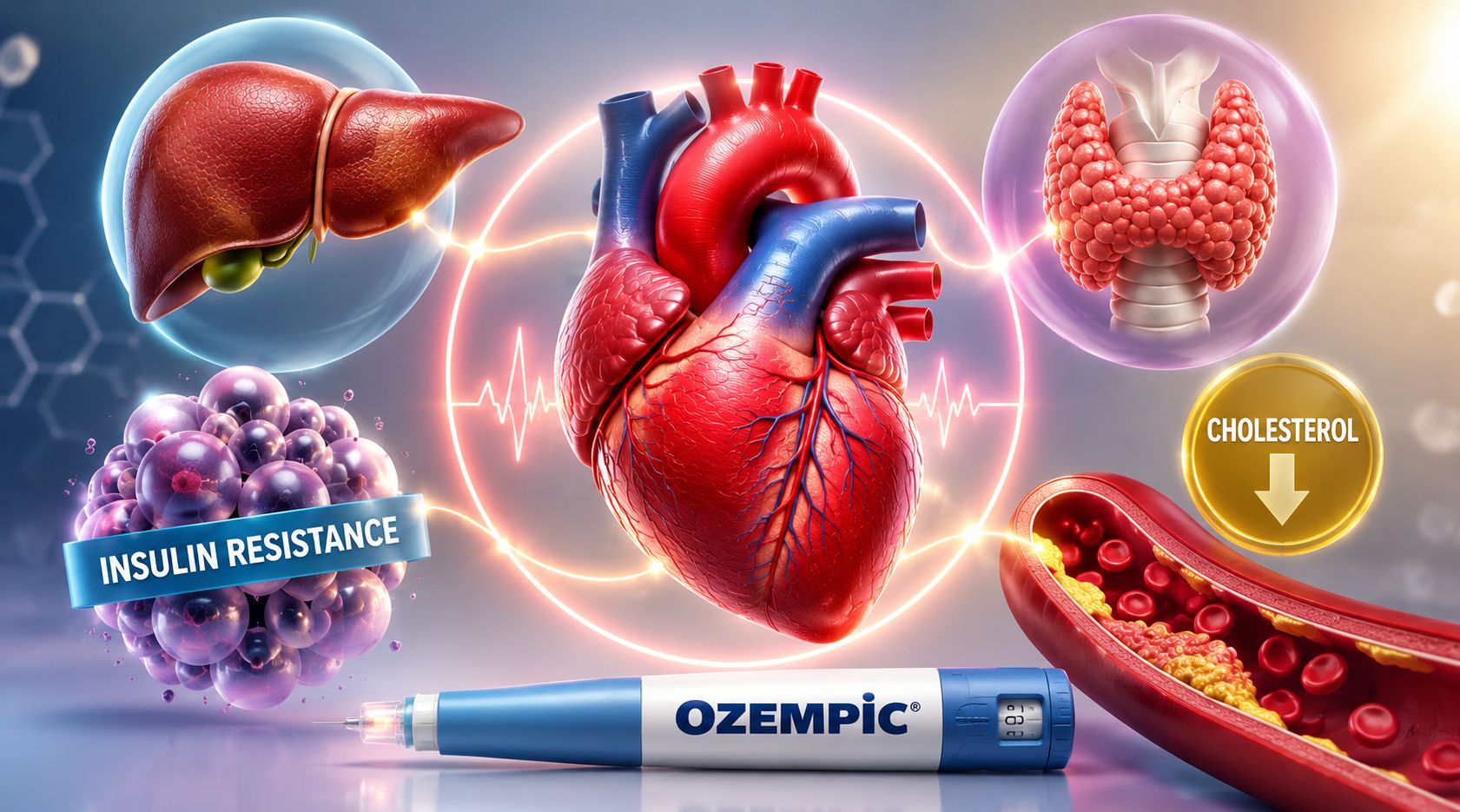
Ozempic has dominated the headlines for diabetes and weight loss. Now it is making news for something completely different — protecting the heart.
Yes, the heart.
Research on semaglutide, the active ingredient in Ozempic, is showing a lower risk of heart attack, stroke and heart-related death in certain people. A drug most people associate with blood sugar and weight loss is now changing what researchers are seeing in heart health.
And that leaves one very big question. Why is this happening? Weight loss is part of the answer, but it may not explain all of the heart benefits being seen.
So what is Ozempic actually doing that could have such a powerful effect on the heart?
What is Ozempic actually doing for heart health?
Research is now showing that the benefits of Ozempic may reach far beyond weight loss. In one of the largest studies, more than 17,000 people who were overweight or obese and already had heart disease were followed. Researchers found a 20% reduction in the risk of heart-related death, heart attack or stroke.
Weight loss is clearly part of the benefit, but it doesn’t explain the results on its own. Ozempic can also improve blood sugar, reduce visceral fat and improve the way the body responds to insulin. Those changes matter because high blood sugar, excess visceral fat and insulin resistance are all closely connected with heart disease.
Insulin resistance is especially important because it can be developing for years before diabetes appears. During that time, triglycerides can rise, inflammation can increase, blood pressure can change and fat can accumulate around the organs and inside the liver. All of this can increase the strain on the heart and blood vessels long before someone realizes there is a problem.
So to understand why Ozempic may benefit the heart, insulin resistance is one of the first places to look.
How insulin resistance affects heart health
Insulin helps move glucose from your bloodstream into your cells, where it can be used for energy. But when your cells are exposed to that insulin signal over and over again, they can become less responsive to it.
Think about yelling at your kids over and over. Eventually they stop listening. That’s essentially what is happening with insulin resistance. Your cells stop responding properly to insulin, so your body has to produce more insulin to try to get the same response.
For a while, your body can compensate. It can keep producing more insulin and your blood sugar may still look normal, which is why insulin resistance can be developing long before prediabetes or diabetes shows up on a blood test.
But insulin resistance doesn’t only affect blood sugar. Triglycerides can rise, visceral fat can increase, fat can build inside the liver, inflammation can increase and blood vessel function can change. These are also some of the same factors that increase heart risk.
So when Ozempic improves insulin resistance, the benefit can reach much further than glucose control. Improving the way your cells respond to insulin can also affect several of the factors that have been putting pressure on your heart.
And two of the biggest pieces of that connection are visceral fat and liver fat.
Why visceral and liver fat matter to your heart
Visceral fat is the fat stored around your organs, and it has a strong link to insulin resistance. Too much visceral fat is also linked with higher triglycerides, inflammation and a greater risk of heart disease.
Fat can also build up inside the liver, especially when you have insulin resistance. Too much liver fat can make it harder for your body to control blood sugar and triglycerides, and both can increase heart risk.
A body-composition study of people using semaglutide found that they lost body fat, including visceral fat around the organs. This is important for heart health because visceral fat isn’t just stored weight. It is closely linked with insulin resistance, inflammation and high triglycerides, so reducing it can help improve more than the number on the scale.
However, as body fat comes down quickly, that fat doesn’t just disappear. It has to be released from storage and used for energy, and your liver has a major role in handling that process.
What rapid weight loss means for your liver
Your liver already has a lot to do. It helps control blood sugar, processes fats, handles triglycerides and cholesterol and produces bile. When you’re losing weight quickly, those jobs don’t stop, which is why liver health still matters while the number on the scale is coming down.
And there are two sides to what we’re seeing with Ozempic. Research has shown benefits for liver fat and liver health, but rare cases of liver injury associated with semaglutide have also been reported. In one recent case, liver function improved when the medication was stopped, then liver enzymes climbed again when it was restarted.
These cases appear to be rare, and there is still a lot we don’t know about why they happen. But they are a reminder that losing weight doesn’t automatically tell you how well your liver is functioning.
And your liver has another connection to heart health that has nothing to do with body fat. It also plays a role in thyroid hormones and the way your body handles cholesterol.
How the liver and thyroid affect cholesterol and heart health
Your liver plays an important role in thyroid hormone metabolism. Your thyroid produces mostly T4, while tissues throughout the body, including the liver, help convert and metabolize thyroid hormones so they can be used by your cells.
Why does that matter to your heart?
Because thyroid hormones affect heart rate, how strongly your heart contracts, blood vessels and blood pressure. They also influence the way your liver handles cholesterol.
Thyroid hormones influence LDL receptors in the liver, and those receptors help pull LDL cholesterol out of your bloodstream. When thyroid hormone activity is low, LDL clearance can slow and LDL cholesterol can rise.
Then there is bile. Your liver uses cholesterol to make bile acids, giving your body another way to use and move cholesterol. If liver function, thyroid hormone activity and cholesterol handling are all connected, it becomes much easier to see why the liver and thyroid belong in an article about heart health.
Follow it through. Insulin resistance can increase visceral and liver fat. Liver fat can make insulin resistance worse. The liver is involved in triglycerides and cholesterol. Thyroid hormones affect the heart directly and also influence how efficiently LDL cholesterol is cleared.
The heart isn’t sitting at the beginning of that chain. It is feeling the effects of what is happening further upstream.
Supporting a healthy heart during weight loss and beyond
One of the biggest lessons from the Ozempic research is that supporting a healthy heart goes far beyond losing weight. Insulin resistance, excess visceral and liver fat, high blood sugar, triglycerides and cholesterol can all increase heart risk. The liver and thyroid matter too because they help control many of the functions that affect the heart.
And these are things that matter before you lose weight, while the weight is coming off and after you’ve reached your goal. Reducing excess fat and supporting a healthy insulin response can help address some of the factors that increase heart risk. Supporting healthy liver function helps your body manage blood sugar, fats and cholesterol, while healthy thyroid function matters because thyroid hormones affect the heart directly and influence the way cholesterol is cleared from the blood.
Food, movement and healthy lifestyle choices are always going to matter, but targeted supplements can give you another way to support these functions. The key is choosing supplements based on what you actually want to support, whether that’s healthy fat metabolism and insulin response, liver function and bile flow, or thyroid hormone production and function.
So let’s look at the supplements that can support these different functions and why each one has a place when you’re looking after your heart before, during and after weight loss.
Accelerated FAST®
Excess visceral and liver fat don’t only affect your weight. They are closely linked with insulin resistance, and insulin resistance can drive higher blood sugar, triglycerides and inflammation — all of which can affect heart health. This is why reducing excess fat matters for far more than the number on the scale.
Accelerated FAST® is a metabolic fat burning system designed to support appetite suppression, sustained energy and enhanced fat metabolism. It works on several parts of fat metabolism rather than relying on appetite control alone.
BHB ketones help the body use fat and ketones for energy, while Trikatu and cayenne support thermogenesis and fat metabolism. Mukul supports healthy fat metabolism in the liver, which matters when excess liver fat and insulin resistance are already part of the problem. PurCaf® organic caffeine and Theacrine help support sustained energy while your body is using stored fuel.
And there is another piece that matters for insulin resistance. FAST® contains HMB and L-Threonine to support muscle during periods of reduced food intake. Muscle helps clear glucose from your bloodstream, so the goal is to reduce excess fat without sacrificing the muscle that helps your body manage blood sugar.
That gives FAST® a much stronger connection to heart health. The goal isn’t to claim that FAST® treats the heart. It is to support fat metabolism, body composition and insulin response — the same areas that can influence blood sugar, triglycerides, inflammation and heart risk.
For someone who doesn’t want to use Ozempic, FAST® provides a completely different approach to appetite and fat metabolism. It doesn’t mimic a GLP-1. It supports the body’s own ability to use stored fat for energy while helping control appetite and maintain energy.
Accelerated Liver Care®
Your liver has a much bigger connection with heart health than most people realize. It helps control blood sugar and triglycerides, processes fats and cholesterol and produces bile. When liver fat and insulin resistance are already part of the problem, supporting healthy liver function becomes even more relevant.
Accelerated Liver Care® is formulated with TUDCA, Calcium D-Glucarate, Milk Thistle, Kutki, Phyllanthus and Bhringaraj to support healthy liver function and bile flow. These ingredients support the liver as it processes fats and carries out the everyday work involved in healthy metabolism.
Bile also gives us another connection back to heart health. Your liver uses cholesterol to make bile acids, so healthy bile production and flow are part of the way your body uses and handles cholesterol.
And during weight loss, your liver still has all of these jobs to do. Whether you’re using Ozempic or losing weight another way, supporting healthy liver function means supporting the way your body handles blood sugar, triglycerides, fats and cholesterol — all of which can have an effect on heart health.
Acceleradine® Iodine
Your thyroid needs iodine to make thyroid hormones. T4 contains four iodine atoms and T3 contains three, so without enough iodine, your thyroid doesn’t have one of the basic nutrients it needs to produce these hormones.
And thyroid hormones have a direct connection with the heart. They help control heart rate, blood pressure and the way your blood vessels work. They also affect LDL receptors in the liver, which help remove LDL cholesterol from your bloodstream.
Acceleradine® Iodine provides highly bioavailable iodine to support normal thyroid hormone production and healthy thyroid function. This becomes especially relevant when you’re losing weight because your thyroid still needs the right nutrients to keep producing thyroid hormones, regardless of how quickly the number on the scale is changing.
Supporting healthy iodine levels means supporting normal thyroid hormone production, which in turn supports the functions those hormones have in the heart and the way your body handles cholesterol.
Accelerated Thyroid®
Iodine gives your thyroid one of the nutrients it needs to make thyroid hormones, but healthy thyroid function involves more than iodine alone. Your thyroid also needs nutritional support to produce, convert and use those hormones effectively throughout the body.
Accelerated Thyroid® combines thyroid glandular nutrients with nutritional and botanical ingredients to support healthy thyroid function and metabolism. This matters for heart health because thyroid hormones help control heart rate, blood pressure and blood vessel function, while also influencing the way your liver clears LDL cholesterol from your bloodstream.
And this connection doesn’t disappear because you’re losing weight. Healthy thyroid function still matters before, during and after weight loss because of the role thyroid hormones play in both metabolism and the heart.
Supporting healthy thyroid function means supporting hormones that have a direct effect on how your heart works and how your body handles cholesterol.
What Ozempic is teaching us about heart health
The research around Ozempic and heart health is showing us that there is far more going on than weight loss. Insulin resistance, visceral and liver fat, blood sugar, triglycerides, cholesterol, liver function and thyroid function can all have an effect on the heart, and many of these can be changing at the same time as the weight comes off.
This is why the number on the scale should never be the only measure of success. Losing excess fat matters, but so does improving insulin resistance, protecting muscle, supporting healthy liver function and making sure your thyroid has what it needs to function properly. These are things that matter before weight loss, while you’re losing weight and after you’ve reached your goal.
Ozempic may be changing the way we look at weight and heart health, but the bigger message applies whether you use it or not. Looking after your heart means looking after the rest of your body too.
Frequently Asked Questions
Research on semaglutide, the active ingredient in Ozempic, has shown a reduced risk of heart attack, stroke and heart-related death in certain people. The heart benefits may be linked to several changes, including weight loss, improved insulin resistance, lower visceral fat and improvements in blood sugar and other heart-risk markers.
Research has found heart benefits in people who were overweight or obese and already had heart disease but did not have diabetes. This is one of the reasons researchers are looking beyond blood sugar to understand how Ozempic may affect the heart.
Insulin resistance means your cells no longer respond to insulin as well as they should, so your body has to produce more insulin to control blood sugar. Over time, insulin resistance can be linked with high triglycerides, inflammation, high blood pressure, visceral fat and changes in blood vessel function, all of which can increase heart risk.
Yes. Research has shown reductions in visceral fat during treatment. Visceral fat is the fat stored around your organs and is closely linked with insulin resistance, inflammation, high triglycerides and heart disease.
Too much fat stored in the liver is closely linked with insulin resistance and can affect blood sugar and triglycerides. High blood sugar, high triglycerides and insulin resistance can all increase heart risk, which is why liver fat matters beyond liver health alone.
Thyroid hormones help control heart rate, blood pressure and blood vessel function. They also influence LDL receptors in the liver, which help remove LDL cholesterol from your bloodstream. This is one reason low thyroid function can be linked with higher LDL cholesterol.
No. Body composition matters too. The goal is to reduce excess fat, including visceral fat, while protecting muscle and getting enough protein and nutrients. Blood sugar, triglycerides, blood pressure, liver health and thyroid function may also be worth monitoring depending on your individual health needs.
Targeted supplements can support healthy fat metabolism, insulin response, liver function and thyroid function. These all play a role in how your body manages blood sugar, triglycerides and cholesterol, which can directly affect heart health.

Sara Banta
Sara Banta is an NANP Certified Dietary Supplement Professional, Health Coach, and CEO & Founder of Accelerated Health Products. She is also the host of the top-rated podcast Accelerated Health with Sara Banta, where she shares practical strategies to support energy, metabolism, hormones, and overall wellness. Sara is passionate about helping people take control of their health naturally through education and innovative formulations.
- Sara Banta
- Sara Banta
- Sara Banta
- Sara Banta
- Sara Banta
- Sara Banta
- Sara Banta
- Sara Banta
- Sara Banta
- Sara Banta
- Sara Banta
- Sara Banta
- Sara Banta
- Sara Banta
- Sara Banta
- Sara Banta
- Sara Banta
- Sara Banta
- Sara Banta
- Sara Banta
- Sara Banta
- Sara Banta
- Sara Banta
- Sara Banta
- Sara Banta
- Sara Banta
- Sara Banta
- Sara Banta
- Sara Banta
- Sara Banta
- Sara Banta
- Sara Banta
- Sara Banta
- Sara Banta
- Sara Banta
- Sara Banta
- Sara Banta
- Sara Banta
- Sara Banta
- Sara Banta
- Sara Banta
- Sara Banta
- Sara Banta
- Sara Banta
- Sara Banta
- Sara Banta
- Sara Banta
- Sara Banta
- Sara Banta
- Sara Banta
- Sara Banta
- Sara Banta
- Sara Banta
- Sara Banta
- Sara Banta
- Sara Banta
- Sara Banta
- Sara Banta
- Sara Banta
- Sara Banta
- Sara Banta
- Sara Banta
- Sara Banta
- Sara Banta
- Sara Banta
- Sara Banta
- Sara Banta
- Sara Banta
- Sara Banta
- Sara Banta
- Sara Banta
- Sara Banta
- Sara Banta
- Sara Banta
- Sara Banta
- Sara Banta
- Sara Banta
- Sara Banta
- Sara Banta
- Sara Banta
- Sara Banta
- Sara Banta
- Sara Banta
- Sara Banta
- Sara Banta
- Sara Banta
- Sara Banta
- Sara Banta
- Sara Banta
- Sara Banta
- Sara Banta
- Sara Banta
- Sara Banta
- Sara Banta
- Sara Banta
- Sara Banta
- Sara Banta
- Sara Banta
- Sara Banta
- Sara Banta
- Sara Banta
- Sara Banta
- Sara Banta
- Sara Banta
- Sara Banta
- Sara Banta
- Sara Banta
- Sara Banta
- Sara Banta
- Sara Banta
- Sara Banta
- Sara Banta
- Sara Banta
- Sara Banta
- Sara Banta
- Sara Banta
- Sara Banta
- Sara Banta
- Sara Banta
- Sara Banta
- Sara Banta
- Sara Banta
- Sara Banta
- Sara Banta
- Sara Banta
- Sara Banta
- Sara Banta
- Sara Banta
- Sara Banta
- Sara Banta
- Sara Banta
- Sara Banta
- Sara Banta
- Sara Banta
- Sara Banta
- Sara Banta
- Sara Banta
- Sara Banta
- Sara Banta
- Sara Banta
- Sara Banta
- Sara Banta
- Sara Banta
- Sara Banta
- Sara Banta
- Sara Banta
- Sara Banta
- Sara Banta
- Sara Banta
- Sara Banta
- Sara Banta
- Sara Banta
- Sara Banta
- Sara Banta
- Sara Banta
- Sara Banta
- Sara Banta
- Sara Banta
- Sara Banta
- Sara Banta
- Sara Banta
- Sara Banta
- Sara Banta
- Sara Banta
- Sara Banta
- Sara Banta
- Sara Banta
- Sara Banta
- Sara Banta
- Sara Banta
- Sara Banta
- Sara Banta
- Sara Banta
- Sara Banta
- Sara Banta
- Sara Banta
- Sara Banta
- Sara Banta
- Sara Banta
- Sara Banta
- Sara Banta
- Sara Banta
- Sara Banta
- Sara Banta
- Sara Banta
- Sara Banta
- Sara Banta
- Sara Banta
- Sara Banta
- Sara Banta
- Sara Banta
- Sara Banta
- Sara Banta
- Sara Banta
- Sara Banta
- Sara Banta
- Sara Banta
- Sara Banta
- Sara Banta
- Sara Banta
- Sara Banta
- Sara Banta
- Sara Banta
- Sara Banta
- Sara Banta
- Sara Banta
- Sara Banta
- Sara Banta
- Sara Banta
- Sara Banta
- Sara Banta
- Sara Banta
- Sara Banta
- Sara Banta
- Sara Banta
- Sara Banta
- Sara Banta
- Sara Banta
- Sara Banta
- Sara Banta
- Sara Banta
- Sara Banta