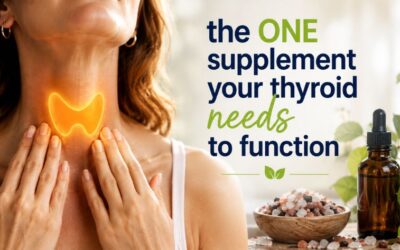
If you’re taking Synthroid®, levothyroxine, Armour Thyroid®, or NP Thyroid® but you’re still exhausted, struggling to lose weight, dealing with brain fog, losing hair, or feeling cold all the time, you’re certainly not alone.
One of the biggest misconceptions I see is that thyroid medication should solve every thyroid symptom. It makes sense to think that way. After all, if your thyroid hormones are being replaced, surely you should feel like yourself again.
For some people, that’s exactly what happens.
For many others, it doesn’t.
That doesn’t necessarily mean your medication isn’t working. More often than not, it means there’s another part of the thyroid conversation that simply isn’t getting enough attention.
Doctors are the experts in diagnosing thyroid disease, interpreting blood work, and prescribing medication. My expertise is helping people understand the nutritional side of thyroid health and how targeted nutritional support works alongside conventional treatment. These aren’t competing approaches—they complement one another beautifully.
One of the biggest myths I’d love to change is the idea that medication has to do everything.
It can’t.
Thyroid medication replaces hormones your thyroid can no longer produce in sufficient amounts. It was never designed to provide the nutritional building blocks your body still depends on to produce energy, support healthy metabolism, maintain normal thyroid hormone activity, and keep the countless biochemical processes that rely on thyroid hormones functioning efficiently.
In other words, medication replaces thyroid hormones.
Nutrition supports the body that has to use them.
Once you understand that simple concept, it becomes much easier to understand why so many people continue to struggle despite taking their medication exactly as prescribed.
Understanding the role of thyroid medication
Whether you’ve been prescribed Synthroid®, levothyroxine, Armour Thyroid®, or NP Thyroid®, your medication has a very specific role. It’s designed to restore thyroid hormone levels when your thyroid gland can no longer produce enough hormone on its own.
For millions of people, that’s life-changing.
However, replacing hormones is only one part of healthy thyroid function.
Once thyroid hormones are available, your body still has to transport them into cells, metabolize them correctly, and use them to support healthy energy production, metabolism, body temperature, cardiovascular function, digestive health, cognitive function, and countless other processes throughout the body. As the American Thyroid Association explains, thyroid hormones influence virtually every organ and tissue, which is why thyroid health affects so much more than simply how tired you feel.
This is also one of the reasons so many people continue to experience symptoms despite faithfully taking their medication.
Research has consistently shown that many patients treated with levothyroxine continue to report fatigue, weight gain, cognitive changes, and reduced quality of life even after their TSH returns to the normal range. A comprehensive review published in the Journal of the Endocrine Society discusses this ongoing challenge and why achieving normal laboratory values doesn’t always mean patients feel well (Persistent hypothyroid symptoms in a patient with a normal TSH level).
I think that’s an incredibly important finding because it changes the conversation.
Instead of immediately assuming your medication isn’t working, it’s worth asking a different question:
Does my body have the nutritional support it needs to make the most of the medication I’m taking?
That’s where nutrition becomes an essential part of the picture—not because it replaces medication, but because medication and nutrition each have their own role.
Your medication provides the hormones.
Your body still needs the nutritional support to use them efficiently.
Why nutrition matters just as much as medication
One of the biggest mistakes I see is believing thyroid health begins and ends with a prescription.
Medication is incredibly important, but it’s only one part of the picture. Its job is to replace thyroid hormones. It isn’t designed to provide the nutritional building blocks your body still depends on every single day to produce energy, support healthy metabolism, maintain normal thyroid physiology, and carry out the thousands of biochemical reactions that keep you alive and functioning.
Think about it this way. If your doctor prescribed medication for high blood pressure, you wouldn’t expect that prescription to provide magnesium or potassium. If you were prescribed insulin, you wouldn’t expect it to replace the role of a healthy diet. Thyroid medication is no different. It replaces hormones, while nutrition supports the body that has to use those hormones effectively.
This is where I believe the conversation around thyroid health has been incomplete for far too long. For years, the focus has been almost entirely on restoring thyroid hormone levels, and while that’s absolutely essential, it’s only one piece of the puzzle. Your thyroid doesn’t work in isolation. It relies on your liver, digestive system, healthy cells, and adequate nutrition to support the normal physiological processes that allow thyroid hormones to do their job.
Nutrition isn’t an alternative to medication—it provides the foundation that allows your body to function the way it was designed. That’s why I’m always surprised when someone tells me they’ve been taking thyroid medication for years but have never once had a conversation about nutrition.
This isn’t theory. It’s basic physiology. It also helps explain why two people taking exactly the same medication at exactly the same dose can have completely different experiences. One person feels fantastic, while the other still wakes up exhausted, struggles to lose weight, can’t think clearly, and wonders why they still feel like they have hypothyroidism.
Often, the difference isn’t the medication itself. It’s whether the body has the nutritional resources it needs to support healthy thyroid function and normal metabolism alongside that medication.
That’s why I don’t believe nutritional support is optional. If you’re serious about supporting your thyroid, nutrition deserves to be part of the conversation from day one. The goal isn’t to replace your medication—it’s to give your body every opportunity to benefit from the medication you’re already taking. When medication and nutrition work together, you’re supporting thyroid health from both directions, and that’s where I believe the greatest opportunity lies.
Signs your thyroid medication may need more nutritional support
One of the most common questions I hear is, “My doctor says my thyroid levels look fine, so why do I still feel like I have hypothyroidism?”
It’s a fair question, and one that deserves a better answer than, “Your blood work is normal.”
Blood tests are incredibly important, but they don’t measure how you feel. If you’re taking your thyroid medication consistently, your thyroid levels have improved, and you’re still struggling with fatigue, brain fog, weight gain, hair loss, dry skin, constipation, poor concentration, feeling cold, brittle nails, or simply feeling like you’ve never regained your energy, your body may be telling you it needs more than hormone replacement alone.
These ongoing symptoms are far more common than many people realize. In fact, research has consistently shown that a significant proportion of people treated with levothyroxine continue to report persistent hypothyroid symptoms despite achieving a normal TSH. A review published in the Journal of the Endocrine Society discusses this challenge in detail and highlights that improving laboratory values doesn’t always translate into patients feeling well (NIH PubMed Central).
This doesn’t mean your medication has failed, nor does it mean you should stop taking it. What it does suggest is that replacing thyroid hormones doesn’t automatically restore every aspect of healthy thyroid physiology. Your body still depends on adequate nutrition to support healthy metabolism, cellular energy production, liver function, and the many biochemical processes that allow thyroid hormones to do the job they were designed to do.
This is why I encourage people to ask a different question. Rather than wondering whether they need a different medication or a higher dose, it’s worth considering whether their body has the nutritional support it needs to work alongside the medication they’re already taking.
That shift in thinking is exactly what inspired me to formulate Accelerated Thyroid®. I didn’t create it to replace thyroid medication. I created it to nutritionally support the body that’s relying on that medication every single day
Why I formulated Accelerated Thyroid®
When I formulated Accelerated Thyroid®, I wasn’t trying to create another thyroid supplement with a long list of fashionable ingredients or make claims that a nutritional supplement could replace prescription medication.
I wanted to create a formula that filled what I believe is one of the biggest gaps in thyroid care: targeted nutritional support designed to work alongside thyroid medication, not compete with it.
Every ingredient in Accelerated Thyroid® earned its place. Each one was selected because it supports healthy thyroid physiology or one of the nutritional pathways the body relies on every day to maintain normal thyroid function.
Kanchnara Guggulu
Kanchnara Guggulu forms the foundation of this formula because it has one of the longest histories of traditional use for supporting healthy glandular function. This classic Ayurvedic formulation combines Kanchnaar (Bauhinia variegata) with Guggul (Commiphora mukul) using the traditional ratios described in ancient Ayurvedic texts rather than the modified formulations commonly found today.
I specifically chose a traditional Kanchnara Guggulu because preserving those original proportions was important to me. While modern research into this herbal combination is still evolving, studies have shown that guggul contains biologically active compounds known as guggulsterones, which continue to be investigated for their role in supporting healthy thyroid physiology and metabolism. Traditional Ayurvedic medicine has also used Kanchnara Guggulu for centuries to support healthy glandular tissue and lymphatic function. Read more in this review of Commiphora mukul published by the National Institutes of Health.
L-Tyrosine
L-Tyrosine was a non-negotiable ingredient because it provides one of the fundamental building blocks required to produce thyroid hormones. Your thyroid combines the amino acid tyrosine with iodine to manufacture thyroxine (T4) and triiodothyronine (T3), making both nutrients essential for normal thyroid hormone synthesis. The relationship between iodine and thyroid hormone production is well established and explained by the National Institutes of Health Office of Dietary Supplements.
Tyrosine is also the precursor for several important neurotransmitters, including dopamine, norepinephrine, and epinephrine. This helps explain why low thyroid function is so often accompanied by fatigue, poor concentration, low mood, and reduced stress resilience. While tyrosine isn’t a treatment for these symptoms, ensuring your body has the nutritional building blocks it needs is an important part of supporting healthy thyroid physiology.
L-Threonine
People are often surprised to see L-Threonine in a thyroid formula, but there’s a very good reason it’s there.
Healthy thyroid function isn’t just about the thyroid gland. The liver plays an important role in thyroid hormone metabolism, making healthy liver function an essential part of the thyroid conversation. L-Threonine is an essential amino acid involved in protein synthesis and contributes to the production of collagen, elastin, and the protective mucin layer that supports digestive health. It also plays an important role in maintaining healthy liver function and normal fat metabolism, which is one of the reasons I chose to include it in this formula. Research has shown that inadequate threonine intake can negatively affect normal liver metabolism, highlighting its importance in overall metabolic health.
Rather than viewing L-Threonine as a “thyroid ingredient,” I see it as an ingredient that supports one of the body’s most important thyroid-supporting organs.
Freeze-dried thyroid glandular
Freeze-dried thyroid glandular has been used by integrative practitioners for decades as part of comprehensive nutritional thyroid formulations. I included a modest amount because I wanted Accelerated Thyroid® to reflect the way experienced practitioners have traditionally approached nutritional thyroid support.
It’s important to understand what this ingredient is—and what it isn’t.
It isn’t intended to replace Synthroid®, Armour Thyroid®, NP Thyroid®, levothyroxine, or any other prescription thyroid medication. It isn’t included to provide therapeutic thyroid hormone, nor should it ever be viewed as an alternative to the treatment prescribed by your doctor.
Instead, it’s one component of a carefully balanced nutritional formula designed to complement conventional thyroid care while supporting healthy thyroid physiology.
When you look at Accelerated Thyroid® as a whole, you’ll notice something important. Every ingredient supports a different aspect of healthy thyroid function, but they all share the same philosophy.
Medication replaces the hormones your thyroid can no longer produce.
Targeted nutritional support helps provide the building blocks your body still depends on every single day to make the most of those hormones.
That’s exactly what I set out to achieve when I formulated Accelerated Thyroid®.
Why iodine deserves its own conversation
Whenever I talk about thyroid health, one nutrient always comes up—iodine.
That’s because iodine isn’t just another nutrient. It’s an essential component of thyroid hormone production, which is why adequate iodine intake remains important throughout life. The National Institutes of Health Office of Dietary Supplements describes iodine as an essential component of thyroxine (T4) and triiodothyronine (T3), the two primary hormones produced by the thyroid gland.
One of the biggest misunderstandings I see is the belief that once you’re taking thyroid medication, iodine is no longer important.
That’s simply not how physiology works.
Your medication replaces thyroid hormones. It doesn’t replace the nutrients your body depends on to support healthy thyroid function and normal thyroid physiology. Those are two very different jobs.
Of course, iodine supplementation isn’t appropriate for everyone. People with Hashimoto’s thyroiditis and other thyroid conditions have unique considerations, which is why I always recommend discussing iodine supplementation with your healthcare practitioner before making changes. The goal isn’t to take the most iodine possible. The goal is to ensure you’re meeting your body’s individual needs safely and appropriately.
This is one of the reasons I developed Acceleradine®.
I wanted to create a highly bioavailable iodine supplement that could be used as part of a comprehensive nutritional approach to thyroid health. It isn’t designed to replace thyroid medication, nor is it intended to “fix” thyroid disease. Instead, it’s designed to provide an essential nutrient that supports normal thyroid physiology and complements the treatment plan you’ve developed with your doctor.
When I talk about nutritional thyroid support, I’m not talking about replacing conventional medicine.
I’m talking about making sure the body has access to the nutrients it still depends on every single day.
Why food isn’t always enough
Whenever I mention supplementation, someone inevitably says, “Can’t I just get everything I need from food?”
I wish the answer was always yes.
In a perfect world, we’d eat nutrient-dense whole foods grown in mineral-rich soils, harvested at peak ripeness, and consumed fresh every day. Unfortunately, that’s not the world most of us live in.
Modern farming practices, food processing, food storage, depleted soils, digestive issues, chronic stress, aging, medications, and individual nutrient requirements all influence both the nutritional value of our food and our ability to absorb what we eat. That’s one of the reasons nutritional deficiencies and insufficiencies remain surprisingly common, even in people who believe they eat a healthy diet.
That’s why I believe supplementation has an important role to play.
Not because supplements are better than food.
They’re not.
Real food should always be the foundation of good health.
However, high-quality supplements can help bridge nutritional gaps when diet alone isn’t providing everything your body needs. They complement a healthy lifestyle in exactly the same way nutritional support complements thyroid medication.
It’s never about choosing one or the other.
It’s about giving your body every advantage you can.
Final thoughts
If there’s one thing I hope you take away from this article, it’s this:
You don’t have to choose between thyroid medication and nutritional support.
They each have an important role to play.
Your doctor is the expert in diagnosing thyroid disease, interpreting your blood work, and prescribing the medication that’s right for you. That medication may be one of the most important things you take each day.
My role is different.
My passion is helping people understand how nutrition supports healthy thyroid function and why giving your body the nutrients it needs is just as important as replacing the hormones it can no longer produce on its own.
For far too long, the conversation has focused almost exclusively on medication.
I believe it’s time to broaden that conversation.
Medication is designed to replace thyroid hormones.
Nutrition supports the body that produces energy from those hormones, metabolizes them, and relies on them to regulate thousands of processes every single day.
When you understand that, it becomes much easier to see why so many people continue to struggle despite taking their medication exactly as prescribed.
The goal isn’t to replace your medication.
The goal is to help your body get the greatest possible benefit from it.
That’s why I formulated Accelerated Thyroid® and why I continue to educate people about the importance of nutritional support. When you combine appropriate medical care with targeted nutrition, you’re supporting your thyroid from both directions—and in my experience, that’s where people often begin to feel the difference.
Frequently asked questions
Yes. Accelerated Thyroid® was specifically formulated to provide nutritional support alongside prescription thyroid medication, not instead of it. As with any supplement, it’s important to let your healthcare practitioner know what you’re taking, particularly if you’re managing a thyroid condition or taking prescription medications.
No. Accelerated Thyroid® is a nutritional supplement, not a replacement for prescription thyroid medication. If your doctor has prescribed thyroid medication, continue taking it exactly as directed unless your treatment plan is changed by your healthcare practitioner.
This is one of the most common questions I hear. While blood tests provide valuable information, they don’t always reflect how you feel. Research has shown that some people continue to experience fatigue and other hypothyroid symptoms despite achieving a normal TSH with levothyroxine therapy. That’s one of the reasons I believe nutritional support deserves to be part of the conversation alongside appropriate medical care.
Everyone is different. Your nutritional status, overall health, diet, medications, and the underlying cause of your thyroid condition all influence how quickly you notice changes. Nutritional support isn’t about creating an overnight transformation—it’s about consistently providing your body with the building blocks it needs to support healthy thyroid function over time.

Sara Banta
Sara Banta is an NANP Certified Dietary Supplement Professional, Health Coach, and CEO & Founder of Accelerated Health Products. She is also the host of the top-rated podcast Accelerated Health with Sara Banta, where she shares practical strategies to support energy, metabolism, hormones, and overall wellness. Sara is passionate about helping people take control of their health naturally through education and innovative formulations.
- Sara Banta
- Sara Banta
- Sara Banta
- Sara Banta
- Sara Banta
- Sara Banta
- Sara Banta
- Sara Banta
- Sara Banta
- Sara Banta
- Sara Banta
- Sara Banta
- Sara Banta
- Sara Banta
- Sara Banta
- Sara Banta
- Sara Banta
- Sara Banta
- Sara Banta
- Sara Banta
- Sara Banta
- Sara Banta
- Sara Banta
- Sara Banta
- Sara Banta
- Sara Banta
- Sara Banta
- Sara Banta
- Sara Banta
- Sara Banta
- Sara Banta
- Sara Banta
- Sara Banta
- Sara Banta
- Sara Banta
- Sara Banta
- Sara Banta
- Sara Banta
- Sara Banta
- Sara Banta
- Sara Banta
- Sara Banta
- Sara Banta
- Sara Banta
- Sara Banta
- Sara Banta
- Sara Banta
- Sara Banta
- Sara Banta
- Sara Banta
- Sara Banta
- Sara Banta
- Sara Banta
- Sara Banta
- Sara Banta
- Sara Banta
- Sara Banta
- Sara Banta
- Sara Banta
- Sara Banta
- Sara Banta
- Sara Banta
- Sara Banta
- Sara Banta
- Sara Banta
- Sara Banta
- Sara Banta
- Sara Banta
- Sara Banta
- Sara Banta
- Sara Banta
- Sara Banta
- Sara Banta
- Sara Banta
- Sara Banta
- Sara Banta
- Sara Banta
- Sara Banta
- Sara Banta
- Sara Banta
- Sara Banta
- Sara Banta
- Sara Banta
- Sara Banta
- Sara Banta
- Sara Banta
- Sara Banta
- Sara Banta
- Sara Banta
- Sara Banta
- Sara Banta
- Sara Banta
- Sara Banta
- Sara Banta
- Sara Banta
- Sara Banta
- Sara Banta
- Sara Banta
- Sara Banta
- Sara Banta
- Sara Banta
- Sara Banta
- Sara Banta
- Sara Banta
- Sara Banta
- Sara Banta
- Sara Banta
- Sara Banta
- Sara Banta
- Sara Banta
- Sara Banta
- Sara Banta
- Sara Banta
- Sara Banta
- Sara Banta
- Sara Banta
- Sara Banta
- Sara Banta
- Sara Banta
- Sara Banta
- Sara Banta
- Sara Banta
- Sara Banta
- Sara Banta
- Sara Banta
- Sara Banta
- Sara Banta
- Sara Banta
- Sara Banta
- Sara Banta
- Sara Banta
- Sara Banta
- Sara Banta
- Sara Banta
- Sara Banta
- Sara Banta
- Sara Banta
- Sara Banta
- Sara Banta
- Sara Banta
- Sara Banta
- Sara Banta
- Sara Banta
- Sara Banta
- Sara Banta
- Sara Banta
- Sara Banta
- Sara Banta
- Sara Banta
- Sara Banta
- Sara Banta
- Sara Banta
- Sara Banta
- Sara Banta
- Sara Banta
- Sara Banta
- Sara Banta
- Sara Banta
- Sara Banta
- Sara Banta
- Sara Banta
- Sara Banta
- Sara Banta
- Sara Banta
- Sara Banta
- Sara Banta
- Sara Banta
- Sara Banta
- Sara Banta
- Sara Banta
- Sara Banta
- Sara Banta
- Sara Banta
- Sara Banta
- Sara Banta
- Sara Banta
- Sara Banta
- Sara Banta
- Sara Banta
- Sara Banta
- Sara Banta
- Sara Banta
- Sara Banta
- Sara Banta
- Sara Banta
- Sara Banta
- Sara Banta
- Sara Banta
- Sara Banta
- Sara Banta
- Sara Banta
- Sara Banta
- Sara Banta
- Sara Banta
- Sara Banta
- Sara Banta
- Sara Banta
- Sara Banta
- Sara Banta
- Sara Banta
- Sara Banta
- Sara Banta
- Sara Banta
- Sara Banta
- Sara Banta
- Sara Banta
- Sara Banta
- Sara Banta
- Sara Banta
- Sara Banta
- Sara Banta
- Sara Banta
- Sara Banta
- Sara Banta
- Sara Banta
- Sara Banta
- Sara Banta
- Sara Banta
- Sara Banta
- Sara Banta
- Sara Banta