Peptide therapy can be a big investment, so when you’re doing the injections, following the protocols and spending hundreds — sometimes thousands — of dollars on peptides, you want to get the very best results you can.
And this is what I’m excited about. We’re starting to understand that getting the best results from peptides isn’t just about choosing the right peptide or getting the dose right. It’s also about giving your body the support it needs to respond to that signal.
One of the biggest pieces of that support is amino acids, because whether your peptide is signaling your body to repair tissue, preserve muscle, produce collagen or support recovery, your body still needs the raw materials to make it happen.
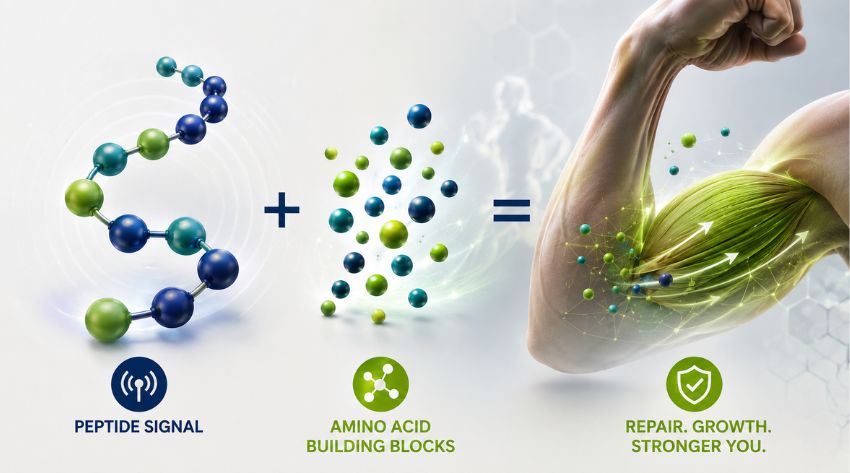
The peptide provides the signal. Amino acids provide the raw materials. Once you understand that relationship, it changes the way you think about supporting your body while using peptides.
Maybe the weight is coming off on your GLP-1, but so is your muscle. Maybe BPC-157 or TB-500 seemed to give you great results initially and then your progress stalled. Maybe you started GHK-Cu expecting changes in your skin and collagen and you’re still waiting to see them.
The immediate reaction is often to question the peptide. Is the dose too low? Do I need a different peptide? Should I increase the dose? But before you start changing the peptide, I want you to ask a different question.
Does your body actually have what it needs to respond to the signal you’re already giving it?
If peptides are made from amino acids, why do you still need amino acids?
This is the question that makes the whole peptide and amino acid conversation click.
A peptide is a short chain of amino acids bonded together in a very specific sequence. And that sequence is everything. Take BPC-157. It is made from 15 amino acids arranged in one exact order. That sequence creates BPC-157 and its specific biological signal. Change the sequence and you no longer have BPC-157.
That’s very different from the amino acids you get from food or an amino acid supplement. When you take essential amino acids as nutrition, they’re absorbed and become available for your cells to use. Your body can use them to make new proteins for muscle, tissue repair, enzymes and many other functions. They are the actual building blocks your body draws from to build and maintain itself. Research shows that essential amino acids provide the precursors needed for protein synthesis, while amino acids such as leucine also help activate the process of muscle protein synthesis.
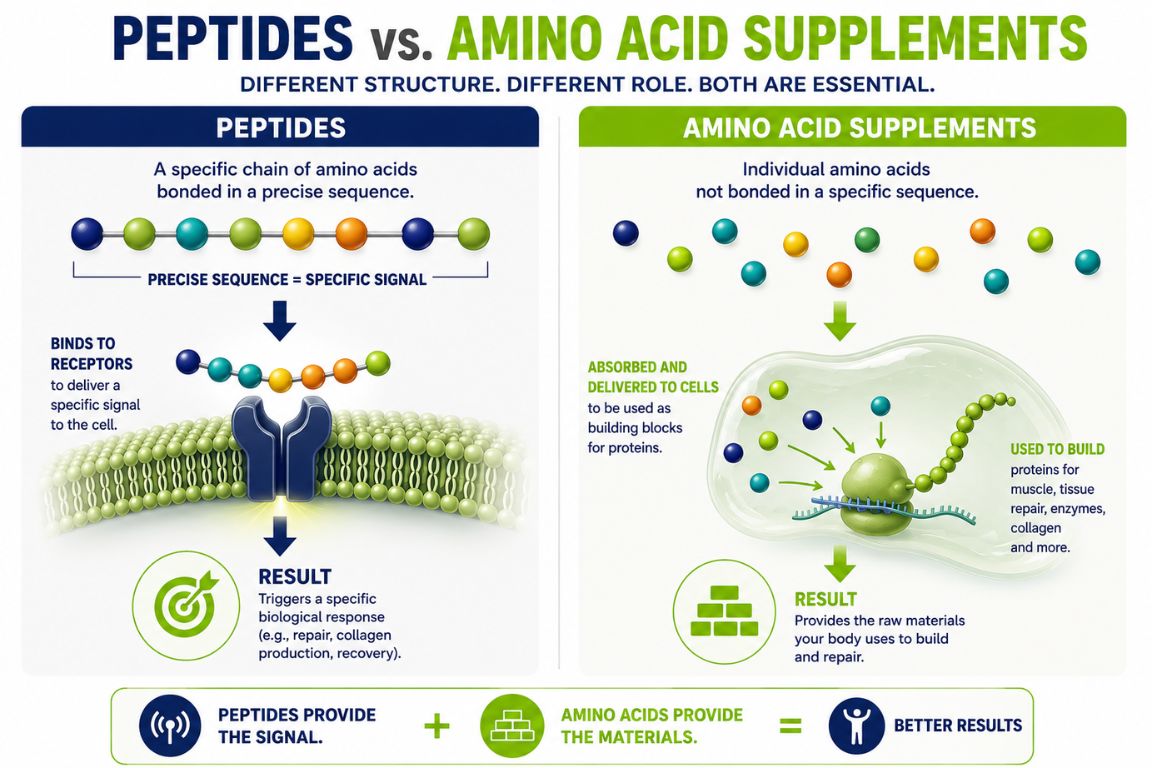
So although we’re talking about amino acids in both cases, they’re doing very different jobs. In a peptide, the amino acids have already been assembled into an exact sequence to create a specific biological signal. In food or an amino acid supplement, you’re supplying amino acids your body can use to make the proteins it needs.
The amino acids in a peptide will eventually be broken down and some may be recycled, but peptide doses are tiny. They don’t provide a meaningful nutritional supply of amino acids.
That’s why taking peptides does not replace your need for amino acids.
Why can peptide signals make amino acids even more important?
Now look at what the peptide signal is asking your body to do.
If BPC-157 is creating a signal associated with tissue repair, your body still has to carry out that repair. Repair involves making new proteins, and making new proteins requires amino acids. If GHK-Cu is creating signals associated with collagen production and tissue remodeling, your body still has to make that collagen. Collagen is a protein built from amino acids.
If you’re using peptides around muscle growth and recovery, your body needs essential amino acids to make new muscle protein. Human research shows that essential amino acids stimulate muscle protein synthesis.
This is the part I really want you to understand. The peptide creates the specific signal. Dietary amino acids supply the building blocks your body needs to carry out processes that involve building and repairing proteins.
So when a peptide increases a signal for repair, rebuilding, collagen production or lean tissue, you don’t want to increase the signal while ignoring the amino acids needed on the other side of that process.
And then we have GLP-1s, where the problem is slightly different. They can dramatically reduce appetite, so you’re eating less food and often much less protein. That means fewer amino acids are coming in at exactly the time you’re trying to lose fat without losing your muscle.
That’s why peptides don’t replace amino acids. The peptide provides the signal. Amino acids give your body what it needs to respond to that signal.
GLP-1s can create an amino acid problem very quickly
This is one of the biggest issues I discuss when I consult with practitioners about nutritional support for their patients and clients using GLP-1s.
Semaglutide, tirzepatide and other GLP-1-based therapies can dramatically reduce appetite. The food noise goes away, portions get smaller and people simply don’t want to eat as much. That may be exactly what they wanted from the medication, but it also means we need to pay very close attention to nutrition.
If someone wasn’t eating enough protein before starting a GLP-1 and is now eating half as much food, where are those essential amino acids coming from?
The scale may be dropping beautifully, but I want to know what is actually coming off the body. Fat? Water? Muscle? Research looking at body composition during GLP-1 therapy shows that weight loss can include reductions in lean mass alongside body fat.
That doesn’t mean the GLP-1 itself is eating your muscle. The issue is that appetite and food intake can fall dramatically while the body’s need for amino acids to maintain muscle hasn’t disappeared.
Muscle is expensive, especially as we get older. It supports strength, body composition, glucose metabolism and metabolic health, and I don’t want to see people giving it away just because the number on the scale is going down.
This is why amino acids need to be part of the GLP-1 conversation from the beginning. The goal isn’t simply weight loss. We want to support fat loss while giving the body what it needs to preserve as much lean tissue as possible.
BPC-157 and TB-500 need amino acids for repair
Now apply exactly the same principle to repair.
People are interested in BPC-157 and TB-500 because of their potential roles in recovery and tissue repair. BPC-157 research is still largely preclinical, so we need more human clinical research, but the nutritional side of repair is already very well understood.
Repair means rebuilding tissue. Rebuilding tissue means making new proteins. And making those proteins requires amino acids.
This is why nutrition becomes so important during recovery from injury or surgery. The body is doing extra repair work and needs the materials to do it. The gut is a great example because the intestinal lining is constantly renewing itself. Research into intestinal amino acid metabolism shows that amino acids play important roles in intestinal growth, integrity and function.
So if BPC-157 or TB-500 is being used because of interest in a repair signal, don’t forget what happens after the signal is received. The body still has to do the repair, and amino acids are part of what it uses to do it.
GHK-Cu still needs amino acids to make collagen
GHK-Cu gives us another really clear example.
People are interested in GHK-Cu because of its relationship with collagen, skin, hair and tissue remodeling. But collagen itself is a protein, and your body has to make it.
That means amino acids.
Collagen has a very specific amino acid structure and is particularly rich in glycine, proline and hydroxyproline. So if you’re creating a signal associated with collagen production, you also want the nutritional building blocks available for the body to actually make collagen.
And then there’s copper. GHK-Cu is a copper peptide, but that doesn’t mean it replaces your body’s nutritional requirement for copper. Copper is an essential mineral used throughout the body and is involved in enzymes required for normal collagen and elastin formation.
This is why I don’t think about GHK-Cu as the entire collagen strategy. We have the specific peptide signal, and then we need the amino acids, copper and other nutrients involved in actually producing and maintaining connective tissue.
Growth hormone peptides still need something to build with
CJC-1295, ipamorelin and tesamorelin are another good example of why a signal and the materials needed to respond to that signal are two different things.
These peptides are used around growth hormone pathways, recovery and body composition. But increasing a growth hormone signal doesn’t magically create new muscle. Muscle protein has to be built from amino acids, and you also need the stimulus from actually using those muscles.
You cannot sit on the couch, take a peptide and ask where your muscles are. It doesn’t work that way.
The peptide may influence the signal. Exercise gives the body the stimulus to adapt. Amino acids provide the building blocks used to make new muscle proteins. All three pieces matter.
The nutritional foundation matters too
Amino acids are the focus here, but I don’t look at them in isolation.
Your body still has to absorb those amino acids, move them where they’re needed and use them to make new proteins. All of that requires a functioning body and energy.
This is why, when I consult with practitioners about supplement support for their patients and clients using peptides, I also look at gut function, liver health, thyroid support and overall nutrient status.
If digestion and absorption are poor, someone may not be getting everything they think they’re getting from the protein they eat. If appetite has dropped dramatically on a GLP-1, they may simply not be consuming enough. And if we’re asking the body to increase repair, preserve lean tissue or make collagen, I want to support the systems involved in actually using those nutrients too.
That brings me to the supplements I use as the nutritional foundation around peptide protocols.
Supplements I use to support peptide protocols
Accelerated AMINOS®
Accelerated AMINOS® provides all nine essential amino acids — the amino acids your body cannot make and has to get through food or supplementation. Unlike the amino acids bonded together to create a specific peptide signal, these essential amino acids are available for the body to use in protein synthesis, including muscle maintenance and tissue repair.
The formula also includes HMB for muscle preservation, along with Senactiv®, AstraGin®, OKG, orotic acid and TMG to support recovery, nutrient absorption, cellular energy and healthy amino acid metabolism. This makes it particularly useful when amino acid intake may be low, such as during GLP-1 use, or when a peptide protocol is increasing signals around repair, recovery or lean tissue.
Accelerated Bio Peptides®
Accelerated Bio Peptides® takes us into more targeted collagen peptide support.
It combines bioactive collagen tripeptides with elastin peptides and other nutritional cofactors designed to support skin, connective tissue and recovery.
I like combining this with Accelerated AMINOS® because they have different jobs. Accelerated AMINOS® provides all nine essential amino acids, while Accelerated BioPeptides® provides targeted collagen peptides and amino acids associated with connective tissue.
There is also some really interesting human research behind oral collagen peptides. Randomized controlled research has shown improvements in skin hydration, wrinkling and elasticity following collagen peptide supplementation.
So if the peptide protocol is focused on skin, collagen, connective tissue or recovery, I want to think about what the body needs nutritionally to support those goals too.
Acceleradine® Iodine
So where does iodine fit into a conversation about amino acids?
Your body can have amino acids available, but it still needs the metabolic machinery and energy to use them. Thyroid hormones help regulate metabolism throughout the body, including processes involved in protein turnover, energy production and how nutrients are used.
And your thyroid needs iodine to make thyroid hormones.
This becomes particularly important to me with GLP-1s because people may be dramatically reducing their food intake at the same time we’re asking the body to preserve muscle and maintain healthy metabolism.
Acceleradine® Iodine supports that thyroid foundation. It isn’t replacing amino acids and it isn’t another peptide signal. It’s supporting the metabolic system that helps the body use the nutrition we’re giving it.
Accelerated Liver Care®
The liver has an even more direct relationship with amino acids.
Once amino acids are absorbed, the liver is one of the major organs involved in amino acid metabolism. It helps regulate amino acids in circulation, converts amino acids when needed and handles the nitrogen produced when amino acids are broken down.
In other words, getting amino acids into the body is only the beginning. The body then has to process and use them.
The liver is also involved in nutrient metabolism, hormone metabolism and normal detoxification pathways. That’s why I include Accelerated Liver Care® when looking at the nutritional foundation around peptide protocols.
And this is also where histamine can enter the conversation. Histamine symptoms are something people sometimes report around peptide use, and histamine metabolism involves several pathways throughout the body. Rather than assuming every reaction is caused by the peptide itself, I want practitioners looking at the person’s whole nutritional and metabolic picture.
Accelerated Liver Care® supports healthy liver function while we’re supplying the amino acids and other nutrients the body needs to respond to the peptide protocol.
The peptide is only one side of the equation
This is the shift I’m excited to see happening.
We spend so much time talking about which peptide, how much and how often. Those things matter, but they’re only one side of the equation. I want us asking another question too. What is that peptide signaling the body to do, and what does the body need to actually do it?
If the signal involves tissue repair, the body needs amino acids to make proteins. If it involves collagen, the body needs the amino acids and nutrients used to build collagen. If someone is using a GLP-1 and eating much less, we need to think about maintaining amino acid intake and protecting muscle.
The peptide provides the specific signal. Amino acids provide building blocks the body can use to respond to that signal. Then we support the rest of the foundation — absorption, thyroid function, liver health and the nutritional cofactors involved in the process.
If you’re investing hundreds or thousands of dollars in peptides, I want you getting the very best from that investment.
Don’t just support the signal. Support the body receiving it.
Frequently asked questions about amino acids
A peptide is made from amino acids bonded together in a specific sequence, and that exact sequence creates the peptide and its biological signal. While that peptide remains intact, those amino acids are functioning together as the peptide rather than as free nutritional amino acids.
The peptide will eventually be broken down and some of those amino acids may be recycled, but peptide doses are tiny. They do not provide a meaningful nutritional supply of amino acids.
Dietary and supplemental amino acids are absorbed and made available for the body to use to make proteins for muscle, tissue repair and many other functions.
Yes, depending on what the peptide is signaling the body to do.
If the signal involves processes such as tissue repair, collagen production or lean tissue, the body still needs amino acids to make the proteins involved in those processes. The peptide doesn’t supply those nutritional building blocks in meaningful amounts.
That’s why I want to support both sides — the signal and the nutrition needed to respond to it.
GLP-1 therapies can dramatically reduce appetite. Less food can mean less protein and therefore fewer dietary amino acids coming in.
Your need to maintain muscle doesn’t disappear because you’re eating less. That’s why amino acid intake and resistance exercise become so important when the goal is losing body fat while preserving lean tissue.
No. BPC-157 itself is made from amino acids, but it is used in tiny amounts for its biological activity. It doesn’t provide a meaningful nutritional supply of amino acids for tissue repair.
The body still needs amino acids from food or supplementation to make the proteins involved in normal tissue maintenance and repair.
No. GHK-Cu is a specific copper-peptide complex. It doesn’t replace your nutritional requirements for amino acids or copper.
If you’re interested in supporting collagen, your body still needs amino acids and the nutritional cofactors involved in normal collagen production.
The liver plays a major role in amino acid metabolism. After amino acids are absorbed, the liver helps regulate how they are processed, converted and circulated and handles the nitrogen produced when amino acids are broken down.
So supplying amino acids is one part of the equation. Supporting the body’s ability to process and use them is another.
Iodine is required for the production of thyroid hormones, and thyroid hormones help regulate metabolism and how the body uses nutrients and energy.
I include iodine because I don’t want to focus on supplying amino acids while ignoring the metabolic foundation that helps the body use those nutrients.
Protein-rich foods are an important source of amino acids and should remain part of a healthy diet. Dietary proteins have to be digested and broken down before their amino acids can be absorbed.
An essential amino acid supplement can be particularly useful when appetite is low, protein intake is difficult or someone needs a convenient way to supplement all nine.

Sara Banta
Sara Banta is an NANP Certified Dietary Supplement Professional, Health Coach, and CEO & Founder of Accelerated Health Products. She is also the host of the top-rated podcast Accelerated Health with Sara Banta, where she shares practical strategies to support energy, metabolism, hormones, and overall wellness. Sara is passionate about helping people take control of their health naturally through education and innovative formulations.
- Sara Banta
- Sara Banta
- Sara Banta
- Sara Banta
- Sara Banta
- Sara Banta
- Sara Banta
- Sara Banta
- Sara Banta
- Sara Banta
- Sara Banta
- Sara Banta
- Sara Banta
- Sara Banta
- Sara Banta
- Sara Banta
- Sara Banta
- Sara Banta
- Sara Banta
- Sara Banta
- Sara Banta
- Sara Banta
- Sara Banta
- Sara Banta
- Sara Banta
- Sara Banta
- Sara Banta
- Sara Banta
- Sara Banta
- Sara Banta
- Sara Banta
- Sara Banta
- Sara Banta
- Sara Banta
- Sara Banta
- Sara Banta
- Sara Banta
- Sara Banta
- Sara Banta
- Sara Banta
- Sara Banta
- Sara Banta
- Sara Banta
- Sara Banta
- Sara Banta
- Sara Banta
- Sara Banta
- Sara Banta
- Sara Banta
- Sara Banta
- Sara Banta
- Sara Banta
- Sara Banta
- Sara Banta
- Sara Banta
- Sara Banta
- Sara Banta
- Sara Banta
- Sara Banta
- Sara Banta
- Sara Banta
- Sara Banta
- Sara Banta
- Sara Banta
- Sara Banta
- Sara Banta
- Sara Banta
- Sara Banta
- Sara Banta
- Sara Banta
- Sara Banta
- Sara Banta
- Sara Banta
- Sara Banta
- Sara Banta
- Sara Banta
- Sara Banta
- Sara Banta
- Sara Banta
- Sara Banta
- Sara Banta
- Sara Banta
- Sara Banta
- Sara Banta
- Sara Banta
- Sara Banta
- Sara Banta
- Sara Banta
- Sara Banta
- Sara Banta
- Sara Banta
- Sara Banta
- Sara Banta
- Sara Banta
- Sara Banta
- Sara Banta
- Sara Banta
- Sara Banta
- Sara Banta
- Sara Banta
- Sara Banta
- Sara Banta
- Sara Banta
- Sara Banta
- Sara Banta
- Sara Banta
- Sara Banta
- Sara Banta
- Sara Banta
- Sara Banta
- Sara Banta
- Sara Banta
- Sara Banta
- Sara Banta
- Sara Banta
- Sara Banta
- Sara Banta
- Sara Banta
- Sara Banta
- Sara Banta
- Sara Banta
- Sara Banta
- Sara Banta
- Sara Banta
- Sara Banta
- Sara Banta
- Sara Banta
- Sara Banta
- Sara Banta
- Sara Banta
- Sara Banta
- Sara Banta
- Sara Banta
- Sara Banta
- Sara Banta
- Sara Banta
- Sara Banta
- Sara Banta
- Sara Banta
- Sara Banta
- Sara Banta
- Sara Banta
- Sara Banta
- Sara Banta
- Sara Banta
- Sara Banta
- Sara Banta
- Sara Banta
- Sara Banta
- Sara Banta
- Sara Banta
- Sara Banta
- Sara Banta
- Sara Banta
- Sara Banta
- Sara Banta
- Sara Banta
- Sara Banta
- Sara Banta
- Sara Banta
- Sara Banta
- Sara Banta
- Sara Banta
- Sara Banta
- Sara Banta
- Sara Banta
- Sara Banta
- Sara Banta
- Sara Banta
- Sara Banta
- Sara Banta
- Sara Banta
- Sara Banta
- Sara Banta
- Sara Banta
- Sara Banta
- Sara Banta
- Sara Banta
- Sara Banta
- Sara Banta
- Sara Banta
- Sara Banta
- Sara Banta
- Sara Banta
- Sara Banta
- Sara Banta
- Sara Banta
- Sara Banta
- Sara Banta
- Sara Banta
- Sara Banta
- Sara Banta
- Sara Banta
- Sara Banta
- Sara Banta
- Sara Banta
- Sara Banta
- Sara Banta
- Sara Banta
- Sara Banta
- Sara Banta
- Sara Banta
- Sara Banta
- Sara Banta
- Sara Banta
- Sara Banta
- Sara Banta
- Sara Banta
- Sara Banta
- Sara Banta
- Sara Banta
- Sara Banta
- Sara Banta
- Sara Banta
- Sara Banta
- Sara Banta
- Sara Banta
- Sara Banta
- Sara Banta
- Sara Banta
- Sara Banta
- Sara Banta