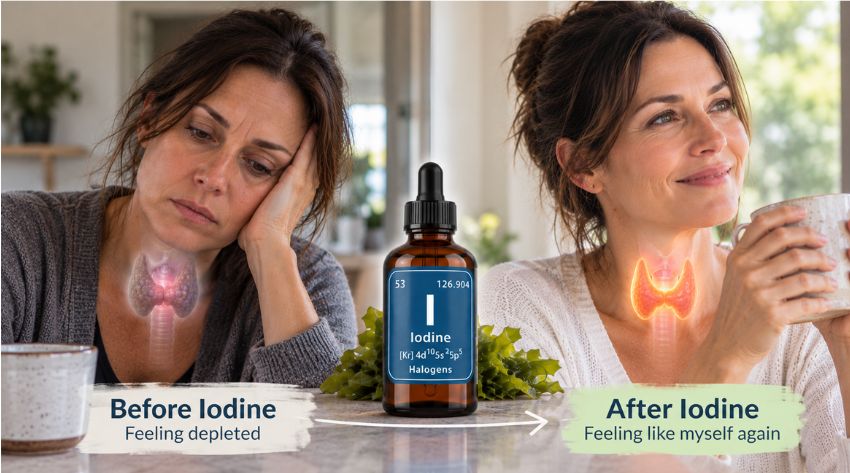







You’re eating less than you used to and the scale still won’t move. You wake up tired, you go to bed tired, and nothing in between feels any different. Your hair is thinning around the part, your hands and feet are always a little cold, and more than once you’ve wondered if this is just what getting older feels like.
But what if these aren’t separate problems?
Your thyroid plays a huge role in your metabolism, energy, body temperature, digestion, hair, skin, mood and hormones. And there is one nutrient your body absolutely cannot make thyroid hormone without.
Iodine.
So if you’re trying to fix the weight, the fatigue, the brain fog, the cold hands and feet and the thinning hair as though they’re five different problems, you could be missing what connects them.
What does your thyroid actually do?
Your thyroid is a small butterfly-shaped gland at the base of your neck. Most of us don’t give it much thought until something goes wrong, yet the hormones it produces affect cells throughout your body and help regulate how your body uses energy.
That’s why a struggling thyroid can feel like your whole body has suddenly slowed down. You’re exhausted even though you’re sleeping. You need a nap to make it through the afternoon. You’re eating well and exercising but the weight isn’t moving. You’re cold when everyone else is comfortable and your digestion has become slow and sluggish.
Then there are the signs you may never have connected to your thyroid. Your hair starts thinning or shedding more than usual. Your skin becomes dry, your nails become brittle, your brain feels foggy and your concentration isn’t what it used to be. You may notice changes in your mood, menstrual cycle or cholesterol, or puffiness around your face, hands and feet.
Suddenly, what looked like a collection of unrelated problems starts to make a lot more sense.
Why can your thyroid labs look normal when you still feel awful?
This is one of the most confusing parts of thyroid health. You know something doesn’t feel right, you have your thyroid tested and you’re told your thyroid labs are normal.
The standard thyroid test most doctors start with is TSH, which stands for thyroid-stimulating hormone. But TSH isn’t actually a thyroid hormone. It’s produced by your pituitary gland and acts as a signal telling your thyroid to produce thyroid hormone.
Your thyroid primarily produces T4. Your body then needs to convert that T4 into T3, the active form your cells can use. Research into iodine and thyroid function explains the production and metabolism of these iodine-containing thyroid hormones and their role in regulating metabolism throughout the body.
So producing thyroid hormone is one part of the picture and being able to convert and use that hormone is another.
That’s why I don’t want you dismissing what your body is telling you just because one number on a lab report falls within a reference range. If you’re still exhausted, cold, foggy, constipated, losing hair and struggling with your weight, talk with your healthcare provider about your symptoms and whether further thyroid testing is appropriate.
But before we make thyroid health complicated, we need to go right back to the beginning and look at what your thyroid actually needs to make those hormones in the first place.
Why is iodine so important for your thyroid?
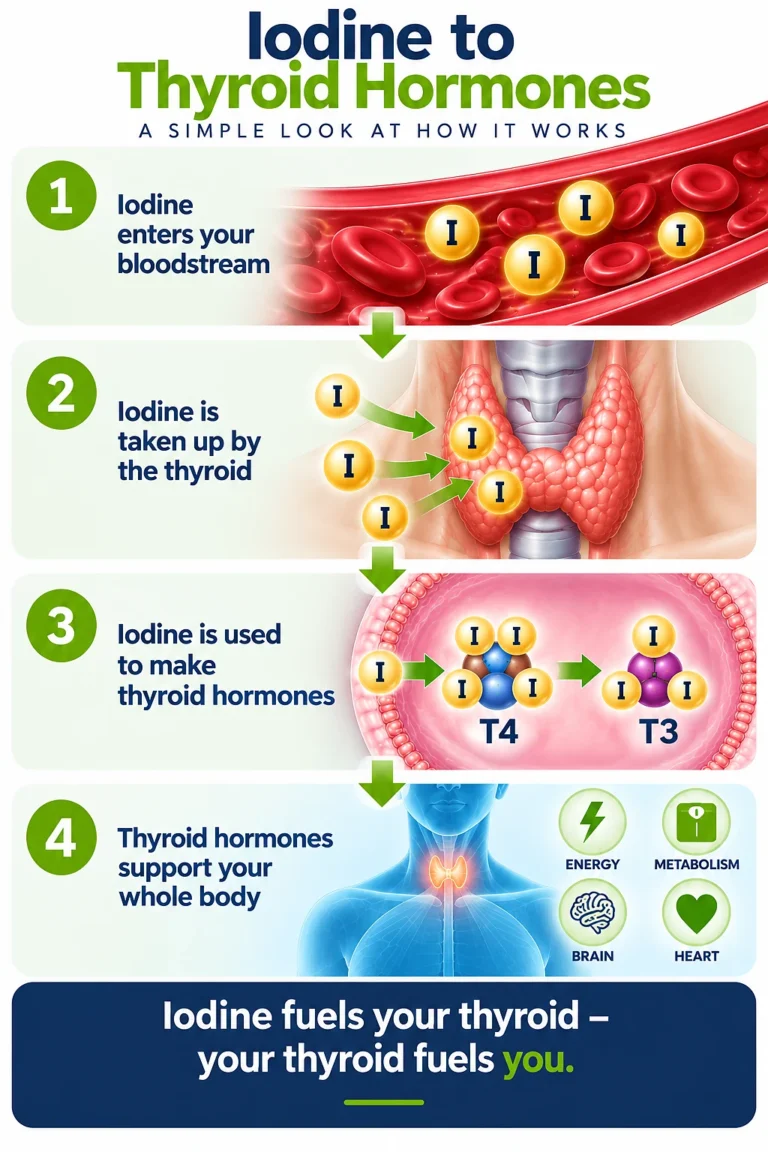
Your thyroid cannot make thyroid hormone without iodine.
In fact, iodine is an essential component of thyroid hormones. T4 contains four iodine atoms and T3 contains three. Your thyroid combines iodine with the amino acid L-tyrosine as part of the process of making thyroid hormones.
So iodine isn’t just a nutrient that happens to support your thyroid. It is part of the hormones themselves.
That’s how fundamental it is.
And yet iodine is something many people barely think about. We hear constantly about vitamin D, magnesium, protein and other nutrients, but how often do you stop and ask whether you’re getting enough iodine?
Iodine deficiency can interfere with normal thyroid hormone production, which is why adequate iodine intake is so important for normal thyroid function.
At the same time, we’re exposed to chlorine, fluoride and bromine. These are halogens, the same family of elements as iodine. Then add the changes we’ve seen in our diets and food supply. Eating what you consider a healthy diet doesn’t automatically mean you’re getting every nutrient your body needs.
When your thyroid depends on iodine to make thyroid hormone, that’s something worth paying attention to.
Iodine is about far more than your thyroid
Your thyroid may be what iodine is best known for, but iodine doesn’t exist exclusively in the thyroid.
Research into iodine metabolism has identified iodine in tissues beyond the thyroid, including the mammary glands, gastric mucosa, cervix and salivary glands.
That’s important because it changes the way we think about iodine. It’s easy to put iodine into a thyroid-only box, but your body doesn’t work in neat little boxes.
Iodine transport has also been identified in several tissues outside the thyroid, including the salivary glands, stomach and lactating breast. Researchers continue to investigate what iodine is doing in these tissues and the potential roles it may have beyond thyroid hormone production.
This becomes even more interesting when we think about women and hormonal changes. The breasts and reproductive tissues are among the areas where iodine has been studied, which is another reason I don’t want you thinking about iodine as something that matters only to one little gland in your neck.
Your thyroid absolutely needs iodine, but that’s not the only place in your body where iodine shows up.
What can interfere with iodine?
Now we come back to those halogens.
Bromine, chlorine and fluoride are chemically related to iodine, and we’re exposed to them through different parts of modern life. Completely eliminating your exposure isn’t realistic, but you can become more aware of it and reduce unnecessary exposure where it makes sense.
Then there is your actual iodine intake.
If you’re not getting enough iodine to begin with, your thyroid still has to try to make thyroid hormones with the raw materials available to it.
And remember what those thyroid hormones help regulate. Your metabolism, energy, body temperature and many other processes throughout your body are connected to thyroid function.
This is why I keep coming back to iodine.
Getting more iodine into your body
Once you realize how much your body depends on iodine, getting enough of it becomes the obvious next question.
Food sources of iodine include seaweed, fish, dairy and eggs, but the amount you get can vary considerably depending on what you eat and where that food comes from. And for many people, those foods aren’t making a regular appearance on the plate.
That’s where an iodine supplement can help.
Acceleradine® Iodine is a liquid iodine supplement we created to make it easy to add iodine to your daily routine. But the form of iodine you choose matters, because iodine supplements aren’t all made the same way.
What makes Acceleradine® Iodine different?
Not all iodine supplements are the same, and the form of iodine matters.
Acceleradine® Iodine isn’t Lugol’s iodine and it isn’t a basic potassium iodide drop. It’s made with singlet iodine and has just three ingredients including singlet iodine, non-GMO 200-proof alcohol and scalar frequency.
The iodine comes from deposits deep beneath the ground in South America rather than from marine sources, and the singlet form means you’re getting iodine without the potassium used in potassium iodide products.
This matters because iodine is so much bigger than another supplement to add to your routine. Your thyroid needs iodine to make thyroid hormone. T4 contains four iodine atoms and T3 contains three, and those hormones influence your metabolism, energy, body temperature and so much of what we’ve been talking about.
That’s exactly why Acceleradine® Iodine was created. To provide iodine in a very different form from the traditional iodine supplements you may already know.
And when you’re exhausted, cold, foggy, struggling with thinning hair and wondering why your metabolism feels like it has slowed right down, iodine is one of the fundamental nutrients you don’t want to overlook.
What could you notice when your body gets the iodine it needs?
I don’t want you thinking about this as an overnight transformation. Your body didn’t get where it is overnight, and supporting your nutritional status takes time.
Instead, start paying attention to how you actually feel. Is your energy becoming more consistent throughout the day? Are you still freezing when everyone else is comfortable? Does your brain feel clearer? Are you getting through the afternoon without feeling completely drained? How does your hair feel? What is happening with your digestion?
And then there is the weight.
If your metabolism has felt like it has slammed on the brakes, continually eating less and pushing yourself harder may leave you even more exhausted. Thyroid hormones play an important role in normal metabolism, and your thyroid needs iodine to make those hormones.
This isn’t about claiming iodine is a weight loss supplement. It isn’t.
It’s about understanding what your metabolism depends on and making sure your body has the nutrients it needs to function normally.
What about the rest of your thyroid support?
Iodine is the foundation because your thyroid cannot make thyroid hormone without it. But there are other nutrients involved in normal thyroid function too, and this is where broader thyroid support can be useful.
Your thyroid uses L-tyrosine along with iodine when building thyroid hormones. Your body also needs nutrients and minerals for the many reactions involved in producing, converting and using those hormones.
This is why Accelerated Thyroid® can be paired with Acceleradine® Iodine when you want broader nutritional thyroid support. It contains L-tyrosine along with traditional Ayurvedic herbs, a freeze-dried grass-fed thyroid glandular from New Zealand, magnesium BHB and L-theanine.
But I want to keep the order clear.
Iodine is not an afterthought in thyroid health. It is an essential part of thyroid hormone itself.
When taking the products together, Acceleradine® Iodine goes first. I recommend waiting around 12 to 15 minutes before taking Accelerated Thyroid® and other supplements. Accelerated Ancient Salt® can also be added to provide naturally occurring trace minerals.
If you’re taking levothyroxine or another prescription thyroid medication, don’t stop or change your medication on your own. Talk with your prescribing healthcare professional and continue monitoring your thyroid labs.
Could iodine deficiency be what you’ve been missing?
Think back to how you felt when you started reading this.
You’re exhausted despite sleeping. You’re cold when everyone else seems comfortable. Your hair is thinning, your brain feels foggy, your digestion isn’t moving like it used to and the scale doesn’t seem to care how hard you’re trying.
It’s easy to look at those things individually. Maybe you need to eat less. Maybe you need another coffee. Maybe your hair is changing because you’re getting older. Maybe cold hands and feet are just normal for you now.
But when you put the symptoms together, your thyroid deserves a closer look.
And when you look at your thyroid, you cannot ignore iodine.
Your thyroid needs iodine to make thyroid hormone. Those hormones help regulate metabolism, energy and processes throughout your body. Iodine itself is also found in tissues beyond the thyroid and continues to be studied for its broader biological roles.
So instead of continuing to chase every symptom separately, start by asking whether your body is getting one of the most fundamental nutrients your thyroid needs.
Iodine.
Frequently asked questions about iodine and the thyroid
When iodine intake becomes too low, your body may not be able to produce enough thyroid hormone. Symptoms associated with low thyroid function can include fatigue, feeling cold, weight changes, constipation, dry skin, thinning hair and difficulty concentrating. These symptoms can have many causes, so they shouldn’t be used on their own to diagnose iodine deficiency.
Iodine is an essential component of thyroid hormones. T4 contains four iodine atoms and T3 contains three, which means your thyroid needs iodine to make these hormones. You can read more about iodine and thyroid hormone biosynthesis here.
If iodine deficiency interferes with thyroid hormone production, it can affect the metabolic processes regulated by thyroid hormones. Weight changes have many possible causes, however, so difficulty losing weight doesn’t automatically mean you’re deficient in iodine.
Low iodine intake can contribute to inadequate thyroid hormone production, and fatigue is a common symptom of low thyroid function. Persistent fatigue can have many other causes and should be investigated if it continues.
No. Acceleradine® Iodine uses singlet iodine and is different from traditional Lugol’s solution, which typically contains iodine and potassium iodide.
Acceleradine® Iodine is made with singlet iodine rather than potassium iodide. It contains singlet iodine, non-GMO 200-proof alcohol and scalar frequency, with iodine sourced from underground deposits in South America rather than marine sources.
If you’re taking levothyroxine or another prescription thyroid medication, talk with your prescribing healthcare professional before adding iodine or thyroid-support supplements. Your thyroid function and medication requirements should continue to be monitored.
If you have Hashimoto’s or another autoimmune thyroid condition, work with a qualified healthcare professional before changing your iodine intake or beginning iodine supplementation so your thyroid function can be monitored appropriately.

Sara Banta
Sara Banta is an NANP Certified Dietary Supplement Professional, Health Coach, and CEO & Founder of Accelerated Health Products. She is also the host of the top-rated podcast Accelerated Health with Sara Banta, where she shares practical strategies to support energy, metabolism, hormones, and overall wellness. Sara is passionate about helping people take control of their health naturally through education and innovative formulations.
- Sara Banta
- Sara Banta
- Sara Banta
- Sara Banta
- Sara Banta
- Sara Banta
- Sara Banta
- Sara Banta
- Sara Banta
- Sara Banta
- Sara Banta
- Sara Banta
- Sara Banta
- Sara Banta
- Sara Banta
- Sara Banta
- Sara Banta
- Sara Banta
- Sara Banta
- Sara Banta
- Sara Banta
- Sara Banta
- Sara Banta
- Sara Banta
- Sara Banta
- Sara Banta
- Sara Banta
- Sara Banta
- Sara Banta
- Sara Banta
- Sara Banta
- Sara Banta
- Sara Banta
- Sara Banta
- Sara Banta
- Sara Banta
- Sara Banta
- Sara Banta
- Sara Banta
- Sara Banta
- Sara Banta
- Sara Banta
- Sara Banta
- Sara Banta
- Sara Banta
- Sara Banta
- Sara Banta
- Sara Banta
- Sara Banta
- Sara Banta
- Sara Banta
- Sara Banta
- Sara Banta
- Sara Banta
- Sara Banta
- Sara Banta
- Sara Banta
- Sara Banta
- Sara Banta
- Sara Banta
- Sara Banta
- Sara Banta
- Sara Banta
- Sara Banta
- Sara Banta
- Sara Banta
- Sara Banta
- Sara Banta
- Sara Banta
- Sara Banta
- Sara Banta
- Sara Banta
- Sara Banta
- Sara Banta
- Sara Banta
- Sara Banta
- Sara Banta
- Sara Banta
- Sara Banta
- Sara Banta
- Sara Banta
- Sara Banta
- Sara Banta
- Sara Banta
- Sara Banta
- Sara Banta
- Sara Banta
- Sara Banta
- Sara Banta
- Sara Banta
- Sara Banta
- Sara Banta
- Sara Banta
- Sara Banta
- Sara Banta
- Sara Banta
- Sara Banta
- Sara Banta
- Sara Banta
- Sara Banta
- Sara Banta
- Sara Banta
- Sara Banta
- Sara Banta
- Sara Banta
- Sara Banta
- Sara Banta
- Sara Banta
- Sara Banta
- Sara Banta
- Sara Banta
- Sara Banta
- Sara Banta
- Sara Banta
- Sara Banta
- Sara Banta
- Sara Banta
- Sara Banta
- Sara Banta
- Sara Banta
- Sara Banta
- Sara Banta
- Sara Banta
- Sara Banta
- Sara Banta
- Sara Banta
- Sara Banta
- Sara Banta
- Sara Banta
- Sara Banta
- Sara Banta
- Sara Banta
- Sara Banta
- Sara Banta
- Sara Banta
- Sara Banta
- Sara Banta
- Sara Banta
- Sara Banta
- Sara Banta
- Sara Banta
- Sara Banta
- Sara Banta
- Sara Banta
- Sara Banta
- Sara Banta
- Sara Banta
- Sara Banta
- Sara Banta
- Sara Banta
- Sara Banta
- Sara Banta
- Sara Banta
- Sara Banta
- Sara Banta
- Sara Banta
- Sara Banta
- Sara Banta
- Sara Banta
- Sara Banta
- Sara Banta
- Sara Banta
- Sara Banta
- Sara Banta
- Sara Banta
- Sara Banta
- Sara Banta
- Sara Banta
- Sara Banta
- Sara Banta
- Sara Banta
- Sara Banta
- Sara Banta
- Sara Banta
- Sara Banta
- Sara Banta
- Sara Banta
- Sara Banta
- Sara Banta
- Sara Banta
- Sara Banta
- Sara Banta
- Sara Banta
- Sara Banta
- Sara Banta
- Sara Banta
- Sara Banta
- Sara Banta
- Sara Banta
- Sara Banta
- Sara Banta
- Sara Banta
- Sara Banta
- Sara Banta
- Sara Banta
- Sara Banta
- Sara Banta
- Sara Banta
- Sara Banta
- Sara Banta
- Sara Banta
- Sara Banta
- Sara Banta
- Sara Banta
- Sara Banta
- Sara Banta
- Sara Banta
- Sara Banta
- Sara Banta
- Sara Banta
- Sara Banta
- Sara Banta
- Sara Banta
- Sara Banta
- Sara Banta
- Sara Banta
- Sara Banta
- Sara Banta
- Sara Banta
- Sara Banta
- Sara Banta