






What if I told you the reason you’re tired, foggy, crashing at 2 p.m., and feeling like your body just isn’t keeping up may go deeper than needing more coffee or more sleep? What if we need to look all the way down at how your cells are actually producing energy?
When experiencing a loss of energy and fatigue, we look at sleep, stress, caffeine, iron, B12, protein, hormones, menopause. And yes, all of those things can matter. But there is another conversation happening inside your cells, and it starts with your mitochondria.
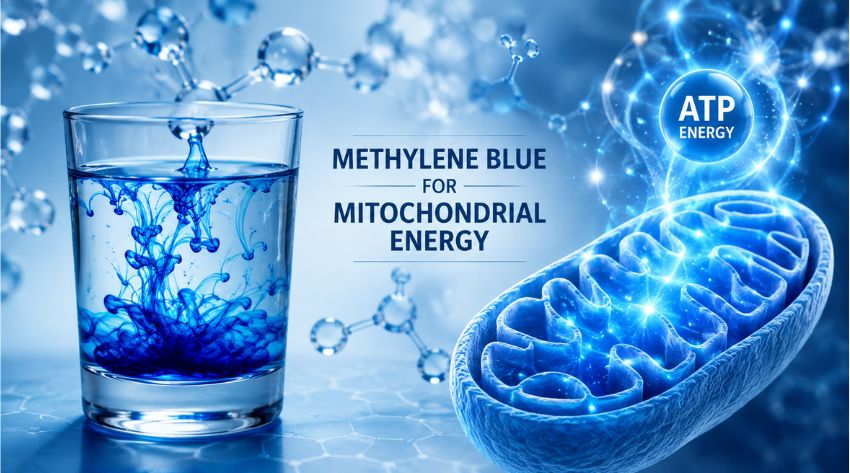
Your mitochondria are the little power plants inside your cells. They take energy from the food you eat and, through a series of processes that use oxygen, help turn it into ATP — the energy your cells actually use. Your brain needs ATP to think and function. Your muscles need it to move and recover. Your liver and gut need energy to do their jobs. Even thyroid hormones are closely connected with the regulation of mitochondrial activity and energy metabolism.
When mitochondrial energy production is disrupted, the effects can reach far beyond simply feeling tired. So rather than asking only how we can push the body harder, there is a much bigger scientific question: how can we support the mitochondria and the way they produce energy in the first place?
That question has put methylene blue firmly in the spotlight. Researchers have been looking at its ability to work within the mitochondria, particularly its role in electron transport and cellular energy production. And that is why this compound, despite being more than 100 years old, has suddenly become one of the most talked-about tools in the longevity and biohacking world.
What is methylene blue and why is everyone talking about it?
Methylene blue is definitely not new. Not even close.
It has a medical history stretching back more than a century. It was synthesized in the late 1800s, became an early synthetic drug used in medicine, was historically used in the treatment of malaria, and has established medical uses today, including the treatment of methemoglobinemia.
So why has methylene blue become so interesting again?
A lot of that excitement comes down to its unusual redox properties and what researchers have discovered about its interaction with mitochondria.
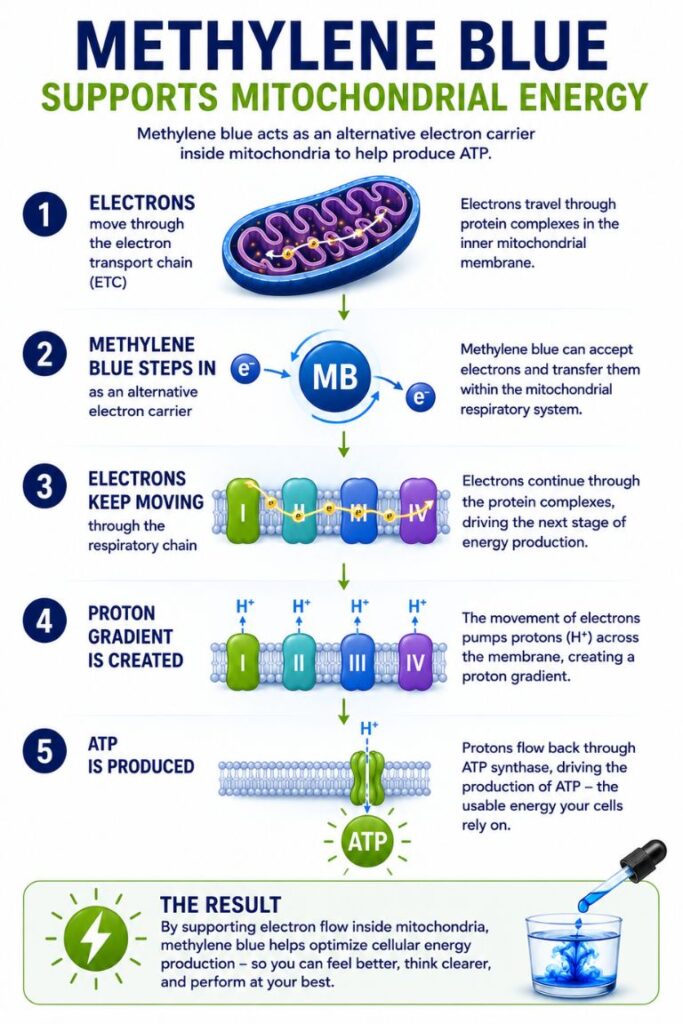
Methylene blue can cycle between oxidized and reduced forms, allowing it to accept and donate electrons. Research into mitochondrial bioenergetics has shown that methylene blue can interact with components of the mitochondrial respiratory chain and act as an alternative electron carrier.
That matters because electron movement is a fundamental part of how mitochondria produce ATP.
So we are not talking about another trendy ingredient that appeared on social media last year. We are talking about a very old compound being looked at through a completely different lens.
And the research is fascinating.
Methylene blue for energy
When you feel exhausted, the usual response is to find something that makes you feel more awake. Coffee. Energy drinks. Pre-workout. Stimulants. Another way to push through the afternoon.
But feeling stimulated and producing cellular energy are not the same biological process.
ATP production depends heavily on mitochondrial oxidative phosphorylation. Inside the inner mitochondrial membrane, electrons pass through the electron transport chain, creating the electrochemical gradient ultimately used to produce ATP.
Researchers studying methylene blue have found that its redox properties allow it to accept and donate electrons within this system. Experimental studies and reviews describe methylene blue as an alternative mitochondrial electron carrier capable of influencing respiration and cellular energy metabolism.
Think of the difference like using a credit card versus improving the system generating the income. A stimulant may help you keep going for longer, but it does not automatically tell us anything about how efficiently your mitochondria are producing ATP.
Methylene blue has attracted attention because researchers are studying something very different — what is happening inside the energy-producing machinery itself.
And to really understand why that matters, we need to go one level deeper.
Methylene blue for mitochondria
Inside your mitochondria is something called the electron transport chain. It sounds complicated, but the basic idea is actually pretty simple.
Electrons move through a series of protein complexes within the inner mitochondrial membrane. That movement helps create a proton gradient, and your mitochondria use that gradient to drive the production of ATP.
Think of it like a tiny energy pathway running through your cells.
Methylene blue has a mild redox potential that allows it to cycle between its oxidized and reduced forms. Researchers have found that it can accept electrons from molecules including NADH and transfer electrons within the mitochondrial respiratory system. Reviews of the research describe methylene blue as a potential alternative electron-transfer carrier within mitochondria.
Low-dose methylene blue has also been studied experimentally for its ability to influence cytochrome oxidase activity, mitochondrial respiration, and oxidative metabolism.
Now you can see why I get so excited about this.
The research is looking at methylene blue right inside the machinery involved in cellular energy production. That opens up a much bigger conversation than simply asking whether something gives you an energy boost.
It also helps explain why so much of the research has moved into one of the most energy-demanding parts of the body — the brain.
Methylene blue for brain health and memory
Your brain uses an enormous amount of energy. Thinking, remembering, focusing, processing information, and communicating between neurons all depend on energy metabolism, which makes mitochondrial function particularly important in brain tissue.
Researchers have therefore investigated methylene blue in areas including cognition, memory, and neurodegenerative disease. Much of that research is still experimental, but we do have an interesting human trial.
A small randomized, double-blind, placebo-controlled study involving 26 healthy adults looked at the effects of a single low oral dose of methylene blue. Researchers found changes in brain activity during attention and short-term memory tasks, along with a 7% increase in correct responses during memory retrieval.
That does not mean methylene blue has been proven to prevent Alzheimer’s or Parkinson’s disease. We need to be very clear about that. Research into methylene blue and neurodegeneration remains an evolving area, and findings from laboratory, animal, or small human studies cannot simply be turned into disease-prevention claims.
But there is a very good reason researchers are interested.
Mitochondrial dysfunction is involved in many areas of neurodegenerative research, and methylene blue’s effects on mitochondrial electron transport have made it an interesting compound to study in that context.
For me, brain longevity is also personal. I have genetic risk factors for Alzheimer’s, so I pay a lot of attention to emerging research around mitochondrial health and cognition. I want to understand what we can do to support brain health long before there is a problem.
Methylene blue and healthy aging
The research does not stop with energy and the brain.
Oxidative stress and mitochondrial dysfunction are also heavily studied in cellular aging, and methylene blue has produced some fascinating findings in laboratory models involving human skin cells.
Researchers working with human dermal fibroblasts found that methylene blue reduced mitochondrial reactive oxygen species, increased fibroblast proliferation, and delayed markers of cellular senescence. In reconstructed 3D human skin models, methylene blue also increased skin hydration and thickness and altered the expression of elastin and some collagen-related genes.
Now, does that mean taking methylene blue will make you wake up looking 20 years younger?
I wish!
It does not. These were laboratory and reconstructed skin-model findings, not clinical proof that oral methylene blue reverses skin aging in humans.
What they do give us is another fascinating look at the relationship between cellular function, oxidative stress, mitochondria, and aging.
Your skin cells need energy. Your brain cells need energy. Your muscles need energy. Repair, recovery, and normal cellular function all depend on energy metabolism.
That is why mitochondrial health has become such a huge area of longevity research.
Where should you buy methylene blue?
Now we need to talk about something I see all the time.
Someone hears about methylene blue, goes onto Amazon, types in “methylene blue,” finds a cheap bottle, and thinks, perfect. Methylene blue is methylene blue.
No.
Methylene blue is manufactured for many different purposes. Products can be intended for industrial applications, laboratory research, aquariums, medical use, or other applications. Those products should not automatically be treated as interchangeable simply because the chemical name on the bottle is the same. I’ve heard of people seeing large bottles of methylene blue in pet stores for fish tanks – and buying that as a supplement!
Just because something has the same name and is cheap, does not tell you everything you need to know about its suitability for human use.
Purity matters. Intended use matters. Manufacturing standards matter. Formulation matters. You need to know what you are actually buying.
I would never recommend taking aquarium-grade or industrial-grade methylene blue internally because it is inexpensive or because someone online says all methylene blue is the same.
It isn’t.
That is why we developed Accelerated Methylene Blue® specifically for human use, with a high-purity formulation and specialized distilled water process.
Methylene blue is absolutely not something I would choose based on price alone. When you are putting something into your body, quality has to come first.
Before adding a methylene blue supplement, look at the foundation
Mitochondria cannot produce energy out of nothing. Oxidative phosphorylation depends on an enormous network of enzymes, electron carriers, nutrients, minerals, oxygen, and metabolic pathways working together.
Micronutrients including iron, copper, magnesium, selenium, and several B vitamins participate directly or indirectly in mitochondrial energy metabolism. Thyroid hormones also regulate mitochondrial biogenesis, respiration, and energy expenditure.
In other words, mitochondrial health does not exist in isolation.
That matters because the biohacking world has a habit of jumping straight to the exciting compound while forgetting the biology underneath it.
The peptide. The nootropic. The methylene blue. Whatever everyone is talking about this week.
But if we are going to talk seriously about cellular energy, we also need to talk about nutrition, mineral status, thyroid function, sleep, metabolic health, oxidative stress, and the systems responsible for processing what enters and leaves the body.
That is why the foundation matters before we start layering more targeted mitochondrial support on top.
Supplements for mitochondrial and cellular energy support
Methylene blue is one part of the cellular-energy conversation. The rest of the body does not suddenly stop mattering because we have found an exciting mitochondrial compound.
Here are the supplements I use when I am looking at cellular energy, thyroid support, liver support, and cognitive health together.
Accelerated Methylene Blue®
Accelerated Methylene Blue® is where the targeted mitochondrial research we have discussed throughout this article comes in.
The interest here is methylene blue’s redox activity, its interaction with mitochondrial electron transport, and the growing research into mitochondrial respiration, oxidative stress, and cognition.
I am not looking at methylene blue as another stimulant. I am looking at why researchers are studying what it does at the cellular level.
Purity is also incredibly important to me, which is why Accelerated Methylene Blue® is formulated specifically for human use using a specialized distilled water process.
Acceleradine® Iodine
Iodine is required for the synthesis of the thyroid hormones T4 and T3. That is established physiology, and it matters here because thyroid hormones have major effects on metabolic rate and mitochondrial activity.
You cannot have a serious conversation about metabolism without including the thyroid.
Acceleradine® Iodine is the iodine I use as part of that nutritional foundation. Rather than treating iodine as some kind of instant energy supplement, I look at what the body actually requires iodine for — normal thyroid hormone production.
Accelerated Liver Care®
The liver also belongs in the conversation because it is central to metabolism. It processes nutrients, hormones, medications, and many compounds entering the body, while also producing bile and carrying out an enormous number of biochemical reactions every day.
So when I am looking at the whole metabolic picture, I am not looking at mitochondria in isolation.
Accelerated Liver Care® is the liver-support component I use alongside the nutritional and mitochondrial pieces of the protocol.
Accelerated CogniBlast®
When brain fog, focus, and cognitive performance are also part of the picture, Accelerated CogniBlast® adds another layer of targeted cognitive support.
Mitochondrial health and cognitive support are not the same thing, which is exactly why I do not expect one product to do everything.
For my own brain-health routine, Accelerodine® Iodine, Accelerated Methylene Blue®, and Accelerated CogniBlast® form a core combination I use.
Accelerated BioPeptides®
Healthy aging is another area where I prefer to look at several biological systems rather than chasing one magic ingredient.
Accelerated BioPeptides® provides peptide-based nutritional support for collagen and connective tissue, making it another part of the healthy-aging approach.
Remember the fibroblast research we discussed earlier? Methylene blue research gives us an interesting look at cellular aging and oxidative stress, while nutritional peptides provide a completely different type of support.
Different tools. Different jobs.
Warning – Methylene blue and serotonin syndrome
Now we need to talk about the safety issue that should be part of every serious conversation about methylene blue.
Methylene blue can inhibit monoamine oxidase A (MAO-A), an enzyme involved in breaking down serotonin. That creates a potential interaction with medications that increase serotonergic activity.
Serotonin syndrome is a potentially serious condition caused by excessive serotonergic activity, and cases have been reported when methylene blue has been given to patients taking serotonergic medications.
There is an important nuance here.
The strongest regulatory warnings and reported cases have largely involved intravenous methylene blue, often at medical doses, in patients also taking serotonergic drugs. FDA labeling has noted that the risk with non-intravenous routes, including oral methylene blue, or with much lower intravenous doses has not been clearly established.
That does not mean we assume oral methylene blue is safe to combine with serotonergic medication.
It means the evidence is incomplete.
If you take an SSRI, SNRI, MAOI, or another medication that affects serotonin, speak with your doctor or pharmacist before using methylene blue. Never stop or change a prescribed medication because you want to start methylene blue.
The mitochondrial research is exciting. The safety conversation matters just as much.
Stop pushing harder, start with the right support
If you are exhausted, foggy, crashing every afternoon, or constantly reaching for something to keep you going, it is easy to think you simply need more energy.
But your body does not get energy from a stimulant. It makes it.
And that is the shift I want you to take away from this.
Your mitochondria are working every second of every day to turn nutrients into ATP — the usable energy that powers almost everything your body does. When that system is struggling, continually trying to stimulate your way around it does not address what is happening underneath.
This is also why mitochondrial health has become such an exciting area of research, and why compounds such as methylene blue are attracting so much attention.
The better question is no longer simply, “What can I take for more energy?”
It is “How well is my body actually making it?”
Because when you start supporting energy at the cellular level, you are finally looking at where energy begins.
Frequently asked questions
Methylene blue can accept and donate electrons, allowing it to interact directly with the mitochondrial electron transport chain. This can support electron flow, mitochondrial respiration, and the processes your cells use to produce ATP. It is one of the reasons methylene blue has become so interesting in mitochondrial and longevity research.
Methylene blue works right at the level where cellular energy is being produced. Its redox properties allow it to participate in electron transfer inside mitochondria, supporting the respiratory processes involved in turning nutrients and oxygen into usable cellular energy.
Research has shown that methylene blue can enhance mitochondrial respiration, improve electron transport, increase oxygen consumption, and influence ATP production. Rather than acting like a quick energy stimulant, it is being studied for what it can do within the actual machinery cells use to make energy.
No. Methylene blue works very differently from caffeine and traditional stimulants. Its connection with energy comes from its effects on mitochondrial respiration, electron transport, and cellular energy metabolism rather than simply stimulating the central nervous system.
Human research has shown that a single low oral dose of methylene blue can influence brain activity and improve memory retrieval. This is particularly fascinating because the brain has enormous energy demands and depends heavily on healthy mitochondrial function.
Methylene blue can cross the blood-brain barrier and interact with mitochondria inside the brain. Because neurons require huge amounts of ATP to function, researchers are particularly interested in how supporting mitochondrial respiration may influence memory, cognition, and healthy brain aging.
Mitochondrial function is closely connected to how our cells age. Methylene blue is being studied for its effects on mitochondrial respiration, oxidative stress, redox balance, and cellular function — putting it right in the middle of some of the most exciting areas of longevity research.
There is some fascinating research here too. Studies using human skin cells and reconstructed skin models have found effects on oxidative stress, cellular senescence, fibroblast activity, elastin, hydration, and collagen-related pathways. It is a great example of why mitochondrial health reaches far beyond simply how energetic you feel.
It can! Methylene blue is a dye, so temporary blue or blue-green discoloration of the tongue or urine can happen. It can also stain surfaces, clothing, and skin, so handle it carefully.
This is an important safety consideration. Methylene blue inhibits monoamine oxidase A (MAO-A) and can interact with medications that increase serotonin, including many antidepressants. Combining them can increase the risk of serotonin syndrome, so speak with your doctor or pharmacist before using methylene blue if you take a serotonergic medication.
Iodine is essential for producing thyroid hormones, and thyroid hormones help regulate metabolic rate, oxygen consumption, and mitochondrial activity throughout the body. You cannot really have a complete conversation about cellular energy without talking about thyroid function.
Your mitochondria need the right raw materials and the right cellular environment to work well. Nutrition, micronutrients, thyroid function, oxygen delivery, metabolic health, sleep, movement, and healthy blood sugar regulation all contribute to how effectively your cells can produce ATP.
Methylene blue is exciting because it brings the conversation about energy back to where energy is actually made — inside the cell.

Sara Banta
Sara Banta is an NANP Certified Dietary Supplement Professional, Health Coach, and CEO & Founder of Accelerated Health Products. She is also the host of the top-rated podcast Accelerated Health with Sara Banta, where she shares practical strategies to support energy, metabolism, hormones, and overall wellness. Sara is passionate about helping people take control of their health naturally through education and innovative formulations.
- Sara Banta
- Sara Banta
- Sara Banta
- Sara Banta
- Sara Banta
- Sara Banta
- Sara Banta
- Sara Banta
- Sara Banta
- Sara Banta
- Sara Banta
- Sara Banta
- Sara Banta
- Sara Banta
- Sara Banta
- Sara Banta
- Sara Banta
- Sara Banta
- Sara Banta
- Sara Banta
- Sara Banta
- Sara Banta
- Sara Banta
- Sara Banta
- Sara Banta
- Sara Banta
- Sara Banta
- Sara Banta
- Sara Banta
- Sara Banta
- Sara Banta
- Sara Banta
- Sara Banta
- Sara Banta
- Sara Banta
- Sara Banta
- Sara Banta
- Sara Banta
- Sara Banta
- Sara Banta
- Sara Banta
- Sara Banta
- Sara Banta
- Sara Banta
- Sara Banta
- Sara Banta
- Sara Banta
- Sara Banta
- Sara Banta
- Sara Banta
- Sara Banta
- Sara Banta
- Sara Banta
- Sara Banta
- Sara Banta
- Sara Banta
- Sara Banta
- Sara Banta
- Sara Banta
- Sara Banta
- Sara Banta
- Sara Banta
- Sara Banta
- Sara Banta
- Sara Banta
- Sara Banta
- Sara Banta
- Sara Banta
- Sara Banta
- Sara Banta
- Sara Banta
- Sara Banta
- Sara Banta
- Sara Banta
- Sara Banta
- Sara Banta
- Sara Banta
- Sara Banta
- Sara Banta
- Sara Banta
- Sara Banta
- Sara Banta
- Sara Banta
- Sara Banta
- Sara Banta
- Sara Banta
- Sara Banta
- Sara Banta
- Sara Banta
- Sara Banta
- Sara Banta
- Sara Banta
- Sara Banta
- Sara Banta
- Sara Banta
- Sara Banta
- Sara Banta
- Sara Banta
- Sara Banta
- Sara Banta
- Sara Banta
- Sara Banta
- Sara Banta
- Sara Banta
- Sara Banta
- Sara Banta
- Sara Banta
- Sara Banta
- Sara Banta
- Sara Banta
- Sara Banta
- Sara Banta
- Sara Banta
- Sara Banta
- Sara Banta
- Sara Banta
- Sara Banta
- Sara Banta
- Sara Banta
- Sara Banta
- Sara Banta
- Sara Banta
- Sara Banta
- Sara Banta
- Sara Banta
- Sara Banta
- Sara Banta
- Sara Banta
- Sara Banta
- Sara Banta
- Sara Banta
- Sara Banta
- Sara Banta
- Sara Banta
- Sara Banta
- Sara Banta
- Sara Banta
- Sara Banta
- Sara Banta
- Sara Banta
- Sara Banta
- Sara Banta
- Sara Banta
- Sara Banta
- Sara Banta
- Sara Banta
- Sara Banta
- Sara Banta
- Sara Banta
- Sara Banta
- Sara Banta
- Sara Banta
- Sara Banta
- Sara Banta
- Sara Banta
- Sara Banta
- Sara Banta
- Sara Banta
- Sara Banta
- Sara Banta
- Sara Banta
- Sara Banta
- Sara Banta
- Sara Banta
- Sara Banta
- Sara Banta
- Sara Banta
- Sara Banta
- Sara Banta
- Sara Banta
- Sara Banta
- Sara Banta
- Sara Banta
- Sara Banta
- Sara Banta
- Sara Banta
- Sara Banta
- Sara Banta
- Sara Banta
- Sara Banta
- Sara Banta
- Sara Banta
- Sara Banta
- Sara Banta
- Sara Banta
- Sara Banta
- Sara Banta
- Sara Banta
- Sara Banta
- Sara Banta
- Sara Banta
- Sara Banta
- Sara Banta
- Sara Banta
- Sara Banta
- Sara Banta
- Sara Banta
- Sara Banta
- Sara Banta
- Sara Banta
- Sara Banta
- Sara Banta
- Sara Banta
- Sara Banta
- Sara Banta
- Sara Banta
- Sara Banta
- Sara Banta
- Sara Banta
- Sara Banta
- Sara Banta
- Sara Banta
- Sara Banta
- Sara Banta
- Sara Banta
- Sara Banta
- Sara Banta
- Sara Banta
- Sara Banta
- Sara Banta
- Sara Banta